Author: Sam

  • 2015 Touring – REAR LIGHTING – TAIL LAMP BASE

    Removal

    1. Remove two screws to release tail lamp assembly from chrome base.

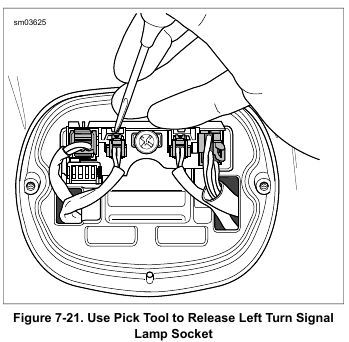
    2. See Figure 7-20 and Figure 7-21. Disconnect all connectors.

    NOTE

    See Figure 7-21. To release turn signal lamp connectors, use a pick or small screwdriver to press latch.

    3. Remove screw at center of chrome base. Push chrome base upward until it is free of fender. Pull out of fender hole.

    4. Remove chrome base.

    5. Remove pin housing/circuit board from chrome base.

    Installation

    1. See Figure 7-20. Feed connectors through openings in chrome base. For best results, feed the larger socket housings first.

    2. Fit bottom of chrome base into fender hole and push down.

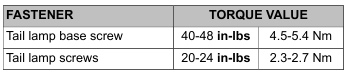
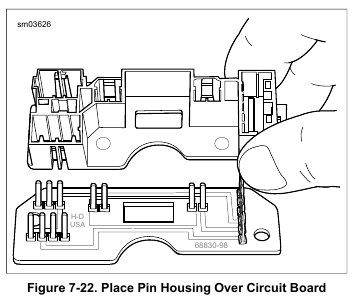
    3. See Figure 7-22. Install pin housing/circuit board with screw. Tighten to 40-48 in-lbs (4.5-5.4 Nm).

    4. Install connectors into circuit board.

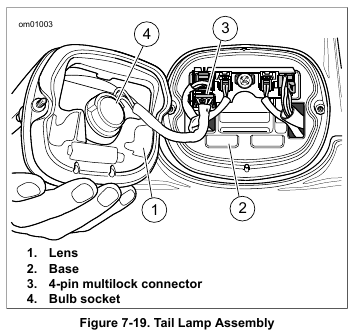
    5. See Figure 7-19. To avoid stressing wires, verify that tail lamp harness is positioned on the outboard side of the rear fender tip lamp and left turn signal lamp harness.

    6. Install tail lamp with two screws. Tighten to 20-24 in-lbs (2.3-2.7 Nm).

    Be sure that all lights and switches operate properly before operating motorcycle. Low visibility of rider can result in death or serious injury. (00316a)

    7. Test tail lamp operation.

  • 2015 Touring – REAR LIGHTING – TAIL LAMP BULB REPLACEMENT

    Removal

    1. Remove two screws to release tail lamp assembly from chrome base.

    2. See Figure 7-19. Disconnect tail lamp connector (3).

    3. Rotate bulb socket (4) 1/4 turn counterclockwise and remove from tail lamp assembly. Pull bulb from socket.

    Installation

    1. Coat base of new bulb with ELECTRICAL CONTACT LUBRICANT. Install new bulb in socket.

    2. See Figure 7-19. Insert socket (4) into tail lamp assembly and rotate 1/4 turn clockwise.

    3. Connect tail lamp connector (3).

    4. Place tail lamp into position against chrome base.

    NOTE

    Over-tightening screws can crack the lens.

    5. Install two screws. Tighten to 20-24 in-lbs (2.3-2.7 Nm).

    Be sure that all lights and switches operate properly before operating motorcycle. Low visibility of rider can result in death or serious injury. (00316a)

    6. Test tail lamp operation.


  • 2015 Touring – AUXILIARY/FOG LAMPS AND BRACKETS – TURN SIGNAL/AUXILIARY/FOG LAMP BRACKET

    Removal

    NOTE

    On models not equipped with auxiliary/fog lamps, removal of lamp bracket is similar.

    1. Road King Models:
    a. See Figure 7-18. Disconnect both lamp connectors (3, 4) located on left steering head.
    b. Cut cable straps securing harnesses to lower fork bracket.
    c. Pull harnesses down through openings in lower fork bracket.
    d. Loosen acorn nuts securing lamp bracket.

    2. Fairing Models:
    a. Remove acorn nuts securing lamp brackets.
    b. Pull lamp bracket away from fork and separate electrical connector.

    3. Remove auxiliary/fog lamp bracket.

    Installation
    1. Fairing Models:
    a. Mate electrical connector.
    b. Install auxiliary/fog lamp bracket.
    c. Install acorn nuts. Tighten to 120-180 in-lbs (13.6-20.3 Nm).

    2. Road King Models:
    a. Install auxiliary/fog lamp bracket with bushings outside bracket.
    b. Tighten acorn nuts to 72-108 in-lbs (8.1-12.2 Nm).
    c. See Figure 7-18. Pull harnesses up through openings in lower fork bracket.
    d. Connect both lamp connectors (3, 4).
    e. Install cable straps securing harnesses to lower fork bracket.


  • 2015 Touring – AUXILIARY/FOG LAMPS AND BRACKETS – AUXILIARY/FOG LAMP HOUSING

    Removal

    1. Disassemble auxiliary/fog lamp. See 7.10 AUXILIARY/FOG LAMPS AND BRACKETS, Auxiliary/Fog Lamp Bulb Replacement.

    2. Remove lamp and bracket:
    a. Road King models: See Figure 7-18. Disconnect auxiliary/fog lamps connector (2 or 3).
    b. Fairing models: Remove auxiliary/fog lamp/bracket assembly. See 7.10 AUXILIARY/FOG LAMPS AND BRACKETS, Turn Signal/Auxiliary/Fog Lamp Bracket.

    3. Remove appropriate terminal(s) from connector housing.
    See A.21 TYCO 070 MULTILOCK UNSEALED CONNECTOR.

    4. See Figure 7-17. Remove screw (1) and washer to release turn signal lamp (11) from bracket.

    5. Use FLARE NUT SOCKET (Part No. Snap-on® FRX181) to remove locknut (10), lockwasher (9) and clamp block (8).

    6. Remove auxiliary/fog lamp from bracket.

    7. Remove rubber washer (7).

    Installation

    1. Lay old auxiliary/fog lamp next to new auxiliary/fog lamp and cut wire to length.

    2. Strip 3/16 in (4.8 mm) of insulation off wire and crimp on new socket terminal. See A.21 TYCO 070 MULTILOCK UNSEALED CONNECTOR.

    3. See Figure 7-17. Install rubber washer (7) on stud.

    4. Position auxiliary/fog lamp housing on bracket. Install clamp block (8), lockwasher (9) and locknut (10).

    5. Using FLARE NUT SOCKET (Part No. Snap-on® FRX181), tighten locknut to 20-24 ft-lbs (27.1-32.5 Nm).

    6. Route wire through passage in bracket and protective conduit.

    7. Install terminal(s) into connector housing. See A.21 TYCO 070 MULTILOCK UNSEALED CONNECTOR. Refer to Table 7-6 or Table 7-7 for terminal location.

    8. Install turn signal lamp and secure with screw (1). Tighten to 96-120 in-lbs (10.9-13.5 Nm).

    9. Install lamp/bracket assembly:
    a. Road King models: Route harness up through lower fork bracket and mate connector. Secure harness to lower fork bracket with cable strap.
    b. Fairing models: Mate connector and install lamp bracket. See 7.10 AUXILIARY/FOG LAMPS AND BRACKETS, Turn Signal/Auxiliary/Fog Lamp Bracket.

    10. Assemble auxiliary/fog lamp. See 7.10 AUXILIARY/FOG LAMPS AND BRACKETS, Auxiliary/Fog Lamp Bulb Replacement.

    11. Check for proper operation and alignment. Adjust if necessary.


  • 2015 Touring – AUXILIARY/FOG LAMPS AND BRACKETS – AUXILIARY/FOG LAMP BULB REPLACEMENT

    Handle bulb carefully and wear eye protection. Bulb contains gas under pressure, which, if not handled carefully, could cause serious eye injury. (00062b)

    Never touch the quartz bulb. Fingerprints will etch the glass and decrease bulb life. Handle the bulb with paper or a clean, dry cloth. Failure to do so could result in bulb damage. (00210b)

    NOTE

    Some models have LED auxiliary lamps. LED lamps contain no replacement bulbs. Replace the lamp assembly if it fails.

    Removal

    1. See Figure 7-16. Loosen screw (5). Pull door (4) from lip of lamp housing.

    2. Disconnect auxiliary/fog lamp connector. Remove lamp (3).

    3. Remove nesting ring (2).

    4. Quartz Halogen: Rotate bulb housing 1/4 turn counterclockwise to remove from lamp.

    Installation

    1. Quartz Halogen: Install new bulb/housing assembly.
    Rotate 1/4 turn clockwise.

    2. See Figure 7-16. Place nesting ring (2) on back of lamp (3) with tab facing away from lamp.

    3. Mate connector.

    4. Engage nesting ring index tab (6) in slot at bottom of lamp housing.

    5. Hold nesting ring in place and rotate lamp so that index tabs engage slots in nesting ring.

    6. Install lamp door (4) on lamp housing with screw (5) centered at bottom. Tighten to 6-10 in-lbs (0.7-1.1 Nm).


  • 2015 Touring – HEADLAMP – HEADLAMP: FLTR MODELS

    Removal

    NOTE

    This headlamp assembly contains no service parts including bulbs and rubber boots. Replace the entire assembly.

    1. Remove outer fairing. See 2.42 OUTER FAIRING AND WINDSHIELD: FRAME MOUNTED FAIRING MODELS.

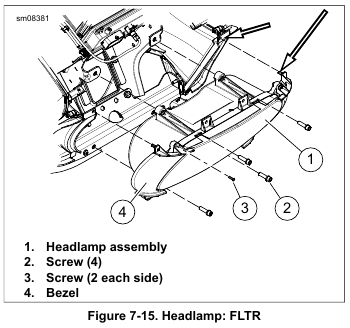
    2. See Figure 7-15. Remove four screws (2).

    3. Remove headlamp assembly. Disconnect headlamp connector.

    4. If necessary, remove screws (3) to remove bezel (4) from each side of headlamp assembly.

    Installation

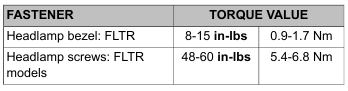
    1. If removed, secure bezel (4) with screws (3) to each side of headlamp assembly. Tighten to 8-15 in-lbs (0.9-1.7 Nm).

    2. Install headlamp connector.

    NOTE

    Verify that pins engage hole in vent housings (arrows) during headlamp installation.

    3. Secure headlamp assembly with four screws (2). Tighten to 48-60 in-lbs (5.4-6.8 Nm).

    4. Install outer fairing. See 2.42 OUTER FAIRING AND WINDSHIELD: FRAME MOUNTED FAIRING MODELS.


  • 2015 Touring – HEADLAMP – HEADLAMP: ALL BUT FLTR MODELS

    Removal

    1. Remove screw at bottom of headlamp door (chrome ring).

    2. Rotate door counterclockwise a few degrees. Pull headlamp door straight forward to remove.

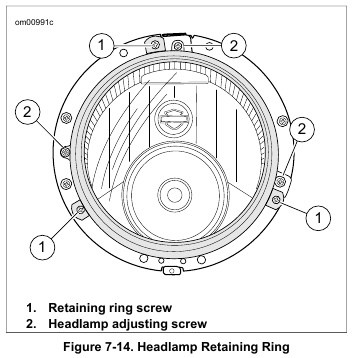
    3. See Figure 7-14. Remove screws (1) securing retaining ring.

    4. Remove headlamp. Disconnect headlamp connectors.

    Installation

    1. Install headlamp connectors.

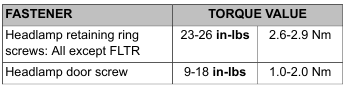
    2. See Figure 7-14. Secure headlamp assembly with retaining ring and screws (1). Tighten to 23-26 in-lbs (2.6-2.9 Nm).

    3. Install the headlamp door (chrome ring):
    a. Verify that rubber seal is in place on headlamp door.
    Apply glass cleaner to seal to ease installation.
    b. With the headlamp door rotated a few degrees counterclockwise, push headlamp door straight onto headlamp.
    c. Rotate clockwise until screw can be installed. Tighten to 9-18 in-lbs (1.0-2.0 Nm).

    Bulb Replacement: Halogen Type

    When replacement is required, use only the specified sealed beam unit or bulb, available from a Harley-Davidson dealer. An improper wattage sealed beam or bulb, can cause charging system problems. (00209a)

    NOTE

    This headlamp assembly uses separate quartz halogen bulbs for the low beam and the high beam. HDI models also contain a position lamp bulb.

    1. Remove headlamp assembly.

    2. Disconnect wire harness connectors from the bulbs.

    3. Rotate bulb assembly 1/4 turn counterclockwise to remove from the reflector/lens.

    Never touch the quartz bulb. Fingerprints will etch the glass and decrease bulb life. Handle the bulb with paper or a clean, dry cloth. Failure to do so could result in bulb damage. (00210b)

    4. Insert new bulb into reflector/lens and rotate 1/4 turn clockwise.

    5. HDI models: Rotate position lamp bulb retainer 1/4 turn counterclockwise to remove. Replace bulb and install bulb retainer in lamp housing.

    6. Connect the wiring harness connectors to the bulbs.

    7. Secure the headlamp assembly and headlamp door.

    Bulb Replacement: LED Type

    LED headlamp contains no replacement bulbs. Replace the entire assembly if failure occurs.


  • 2015 Touring – STARTER – INSTALLATION

    1. Verify that two ring dowels are installed in the primary chaincase or starter flange.

    2. Lubricate O-ring on starter and bore of primary chaincase with light film of clean primary chaincase lubricant.

    3. Apply a drop of LOCTITE 243 MEDIUM STRENGTH THREADLOCKER AND SEALANT (blue) to the starter mounting screws.

    4. Install starter and start both mounting screws. Tighten to 22-24 ft-lbs (29.8-32.5 Nm).

    5. Install engine oil filler cap/dipstick.

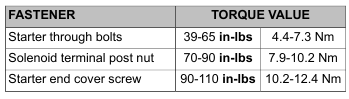
    6. Install battery positive cable on stud of solenoid. Tighten to 70-90 in-lbs (7.9-10.2 Nm). Pull down rubber boot over terminal connections.

    7. Install starter solenoid connector [128] at front of starter.

    Do not over-tighten bolts on battery terminals. Use recommended torque values. Over-tightening battery terminal bolts could result in damage to battery terminals. (00216a)

    8. Connect battery negative cable to battery. Tighten to 60-70 in-lbs (6.8-7.9 Nm).

    9. Install seat. See 2.30 SEAT.


  • 2015 Touring – STARTER – SOLENOID

    Cover and Plunger Removal

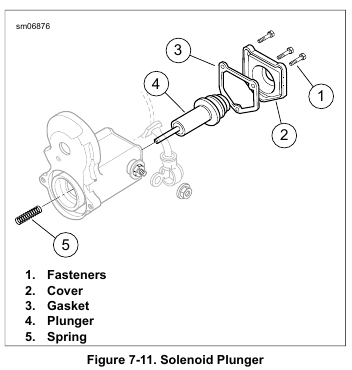
    1. See Figure 7-11. Remove fasteners (1), cover (2) and gasket (3).

    2. Remove the plunger (4) with spring (5).

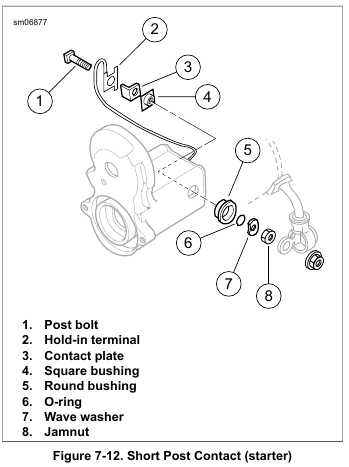
    Short Post Contact: Starter

    1. Disassemble the short post contact:
    a. Remove the hex nut and the ring terminal from the post.
    b. See Figure 7-12. Remove jamnut (8), wave washer (7), O-ring (6) and round bushing (5).
    c. Remove the post bolt (1).
    d. Remove the hold-in terminal (2) from the post bolt.
    e. Remove the contact plate (3) and the square bushing (4).

    2. Assemble the short post contact:
    a. Insert the square bushing into the housing.
    b. Install the contact plate with the 90 degree part of the contact plate against the solenoid winding.
    c. Install the post bolt through the hold-in terminal, the contact plate and the square bushing.
    d. Install the round bushing, O-ring, wave washer and jamnut.

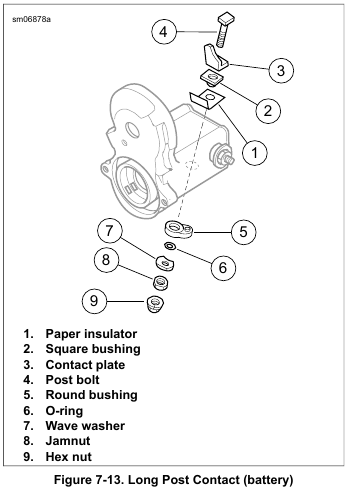
    Long Post Contact: Battery Positive

    1. See Figure 7-13. Remove the long post contact:
    a. Remove hex nut (9).
    b. Remove jamnut (8), wave washer (7), O-ring (6) and the round bushing (5).
    c. Remove post bolt (4), contact plate (3), square bushing (2) and paper insulator (1).

    2. Install the long post contact:
    a. Insert the square bushing through the paper insulator into the housing.
    b. Install the contact plate with the foot against the solenoid winding.
    c. Install the post bolt.

    NOTE

    Check that the index pin on the round bushing fits the blind hole in the housing.

    d. Install the round bushing, O-ring, wave washer and jamnut.

    Plunger and Cover Installation

    1. Apply LUBRIPLATE 110 to the plunger shaft. Install the spring.

    2. Install the plunger and spring in the housing.

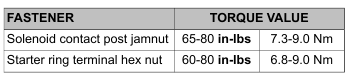
    3. While compressing the plunger, alternately tighten the contact post jamnuts to 65-80 in-lbs (7.3-9.0 Nm).

    4. Check that the contact plates are aligned to the solenoid winding.

    5. Install the cover:
    a. Install a new gasket on the cover.
    b. Install the cover.
    c. Install the fasteners until snug.

    6. Install the starter positive ring terminal.

    7. Install the hex nut. Tighten to 60-80 in-lbs (6.8-9.0 Nm).


  • 2015 Touring – STARTER – DRIVE ASSEMBLY

    Disassembly

    1. Remove end cover, if equipped.

    2. Remove two nuts to release end cover bracket from through bolts, if equipped.

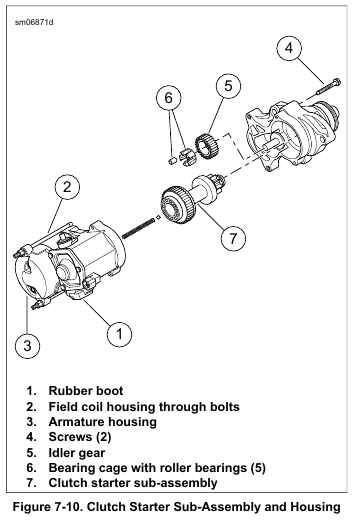
    3. See Figure 7-10. Pull up rubber boot (1). Remove hex nut with captive lockwasher. Release field wire from terminal post on solenoid housing.

    4. Loosen two through bolts (2) to release field coil housing from solenoid housing.

    NOTE

    Do not remove armature and brush plate from housing. No replacement parts are available.

    5. Remove armature housing (3) keeping all contents together for reassembly.

    6. Remove two screws to release drive housing from solenoid housing. Use a rubber mallet to separate drive and solenoid housings, if necessary.

    7. Remove idler gear (5) from bearing cage in drive housing.
    Remove bearing cage with five roller bearings (6) from shaft in drive housing.

    8. Push on end of drive shaft to remove clutch starter sub assembly (7) from drive housing.

    9. Remove solenoid spring and ball from the output shaft of the clutch starter sub assembly.
    Inspection

    1. Inspect two O-rings on drive housing for damage. Replace if necessary.

    2. See Figure 7-10. Verify that the idler gear (5) rotates freely without drag or sticking.

    3. Remove and inspect idler gear. Replace starter motor if the gear is damaged.

    4. Inspect roller bearings (6). Bearings must rotate freely without drag or sticking. Replace starter motor if the bearings are pitted or grooved.

    5. Inspect the steel ball for damage. Replace if necessary.

    NOTE

    Replace entire starter motor if solenoid return spring fails.

    Assembly

    1. See Figure 7-10. Assemble starter.
    a. Lubricate parts with high temperature grease such as LUBRIPLATE 110 during assembly.
    b. Install bearing cage with five roller bearings (6) onto shaft in drive housing.
    c. Confirm that all five roller bearings are installed in grooves of bearing cage and install idler gear (5) over bearing cage.

    2. Lubricate bearings with LUBRIPLATE 110 before installation. Install new clutch starter sub assembly (7) in drive housing seating the larger bearing in the counterbore.

    3. Apply a light film of LUBRIPLATE 110 to solenoid plunger shaft. Install return spring on solenoid plunger shaft.

    NOTE

    Before mating the solenoid and drive housings, apply a thin layer of HARLEY-DAVIDSON HIGH PERFORMANCE SEALANT – GRAY to drive housing between the two housings.

    4. Mate the solenoid and drive housings with two screws.
    Alternately tighten until snug.

    5. Install through bolts to fasten field coil to solenoid housing.
    Tighten to 39-65 in-lbs (4.4-7.3 Nm).

    6. Secure field wire ring terminal to short post on solenoid housing with hex nut with captive lockwasher. Tighten to 70-90 in-lbs (7.9-10.2 Nm). Cover field wire ring terminal with rubber boot (1).

    7. Install end cover bracket onto through bolts, if equipped. Orient longest end of bracket on the field wire side. Install two nuts. Tighten until snug.

    8. Install end cover, if equipped. Tighten to 90-110 in-lbs (10.2-12.4 Nm).