Author: Sam

  • 2015 Touring – ENGINE OIL FLOW – OIL COOLER OPERATION

    Models equipped with Twin-Cooling do not use an oil cooler.

    The flow of oil to the cooler is controlled by a thermostat in an adapter located between the oil filter and the filter mount.

    Pressurized oil flows from the oil filter mount into a passage in the oil cooler adapter. The thermostat is located between the supply and return ports of the adapter. It consists of a temperature sensitive element compressed between a spring and a threaded plug.

    When the engine oil temperature is below 200 °F (93 °C), the thermostat is open. This allows the largest percentage of oil to pass from the supply port to the return port. From the return port, oil flows to the oil filter. A smaller percentage flows through the oil cooler.

    When oil temperature exceeds 200 °F (93 °C), the thermostat closes. This causes all the oil to flow to the oil cooler. Oil circulates through the finned tubes of the cooler to dissipate heat.
    Oil then returns to the cooler adapter through a return hose.
    The oil is then filtered before returning to the crankcase.

    NOTE

    Regardless of whether the thermostat is closed or open, oil is always pressurized in the oil cooler adapter, the oil cooler supply hose, the oil cooler and the oil return hose.

    Check the oil cooler fins for dirt and debris at every service interval.


  • 2015 Touring – ENGINE OIL FLOW – OIL RETURN

    Two illustrations accompany this explanation.
    • Cam support plate oil flow is shown in Figure 3-1.
    • Bottom end oil flow is shown in Figure 3-3.

    The “dual kidney” designation given to the oil pump refers to its two scavenging functions, whereby it simultaneously draws oil from both the cam and flywheel compartments.
    Oil sucked up by the scavenge lobes passes through the scavenge gerotors of the oil pump and is directed through a return channel in the cam support plate (A40). See 3.5 OIL PUMP OPERATION.
    Exiting a hole on the inboard side of the cam support plate, oil enters the upper hole in the crankcase flange (B41).

    Oil flows through the upper passageway in the crankcase (A42), enters a passageway at the front of the transmission housing and empties into the oil pan (Q43) onto the front of the baffle plate (R44).

    Oil flows to the rear of the oil pan along the top of the baffle plate. It then drops from the open end of the baffle plate into the oil pan where it is redirected forward. The baffles (S45) cast into the oil pan slow the circulation of the oil through the pan to enhance cooling.

    Oil pickup occurs in the front compartment of the baffle where a passageway in the casting (S46) directs the flow upward.
    Passing through a second passageway in the transmission housing (Q47), the flow of oil enters the lower passageway in the crankcase (A1) to repeat the circuit.


  • 2015 Touring – ENGINE OIL FLOW – BOTTOM END

    Three illustrations accompany this explanation.
    • Cam support plate oil flow is shown in Figure 3-1.
    • Top end oil flow is shown in Figure 3-2.
    • Bottom end oil flow is shown in Figure 3-3.

    Oil traveling through the horizontal passage (A11-A12) at the top of the cam support plate (en route to the cylinders) also passes through a hole at the top of each camshaft bore. This oil lubricates the journals of the plain bearing cams. Some oil flowing to the rear cylinder sprays through a pin hole to lubricate the secondary cam chain.

    Oil to the rear cylinder also travels down the vertical passage (A27) at the rear of the cam support plate. This oil exits a hole on the outboard side to supply oil to the primary cam chain tensioner (A28).

    The flow of oil in the vertical passage (A29) at the center of the cam support plate passes through a hole on the inboard side. This supplies oil to the secondary cam chain tensioner.
    Oil also sprays through a pin hole (A30) to lubricate the primary cam chain. Oil then flows through a hole in the crankshaft bushing where it enters a passage in the crankshaft (L31).

    Oil flows through the center of the crankshaft and through a cross passage into the right side of the flywheel. Oil enters the crank pin and exits through three holes to lubricate the lower rod bearing set.

    Oil splash and mist created by flywheel rotation lubricates the crankshaft and the camshaft bearings in the right crankcase half. This same action serves to lubricate the sprocket shaft bearing in the left crankcase half (M32).

    Since the oil mist also lubricates the cylinder walls, three holes on each side of the piston (in the area of the third ring land) evacuate excess oil scraped from the walls on the piston downstroke.

    The piston jets (N33) receive oil from the intake lifter bores. They spray the underside of the piston for cooling of the piston crown and skirt area. A check valve in each jet opens only when the oil pressure reaches 12-18 psi (82.7-124.1 kPa), at which point the engine is operating above idle speed. Oil pressure at idle speeds will be 9-12 psi (62.1-82.7 kPa). At this pressure the valve remains closed to prevent over oiling and to provide proper system operating pressure.

    Oil spray from each piston jet also enters a hole at the bottom of each pin boss (O34) to lubricate the piston pin. The spray also allows a portion of the oil to reach the upper rod bushing (D35).

    Surplus oil falls back to the bottom of the flywheel compartment where it collects in the sump area (P36). Oil in the sump is drawn to the scavenge side of the oil pump (B35) through an internal channel (P37, C34).

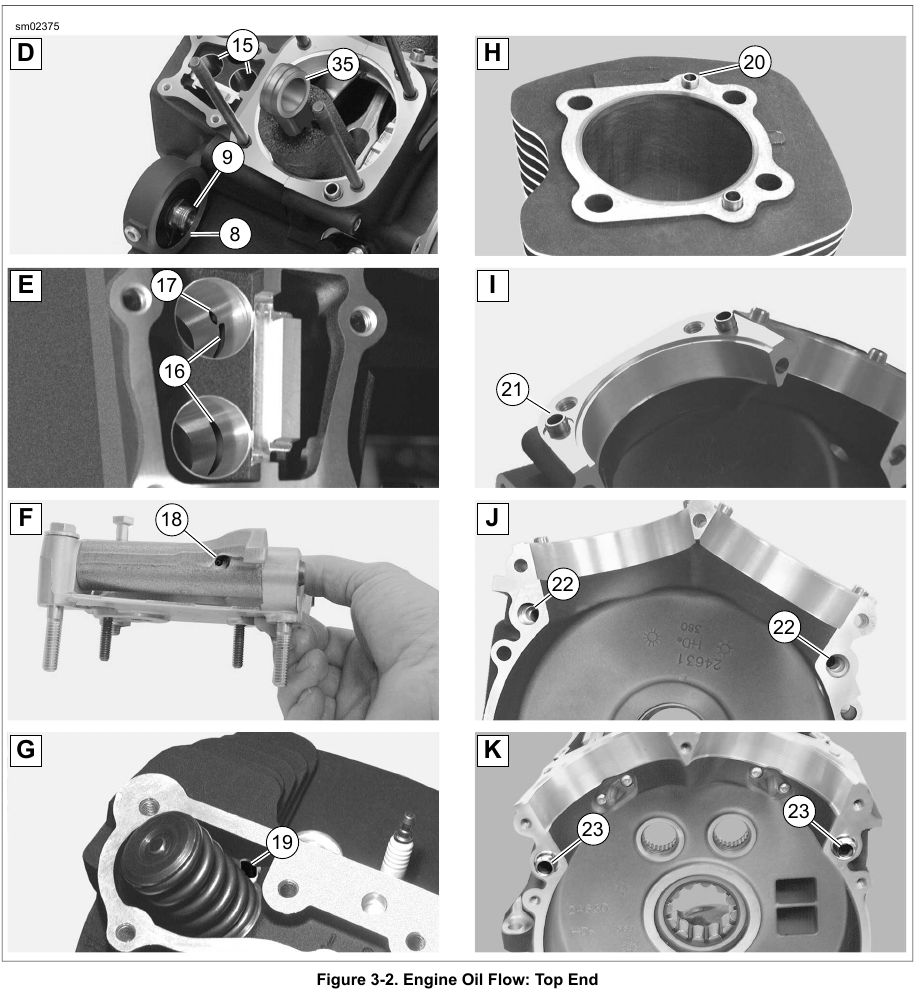


  • 2015 Touring – ENGINE OIL FLOW – TOP END

    Two illustrations accompany this explanation.
    • Cam support plate oil flow is shown in Figure 3-1.
    • Top end oil flow is shown in Figure 3-2.

    Oil passes through a channel in the cam support plate. It exits on the crankcase side through two holes near the top (A11, A12). Oil enters two holes in the crankcase flange (B13, B14).
    One passage leads to the front cylinder and the other to the rear cylinder. Oil then travels through passageways in the crankcase to the hydraulic lifter bores (D15).

    Oil enters each lifter bore through oblong holes (E16), flows around the lifter and enters a hole at the side of the lifter body.
    As the chamber inside the lifter body is filled, the pushrod socket rises to eliminate lash of the valve train components.

    Oil then exits a hole centered in the lifter socket and flows up the hollow pushrods.

    NOTE

    An additional round hole (E17) drilled into the lifter bores feed oil to the piston jets.

    Exiting holes at the top of the pushrods, oil enters the rocker arms lubricating the rocker arm bushings. Oil flows along the rocker arm shafts and exits a pin hole in the outboard side of each rocker arm (F18). This oil lubricates the valve springs and the top of the valve stem.

    Oil runs to the low side of the rocker housing and enters the exhaust valve spring pocket. A drain hole (G19) leads to a passageway in the cylinder head casting.

    Oil exits the bottom of the cylinder head and passes through a dowel pin (H20) on the cylinder flange. Oil flows through a vertical passageway in the cylinder. It then passes through a second dowel pin on the cylinder deck (I21) and enters the left crankcase half.

    Flowing through a horizontal passageway in the left crankcase half (J22), oil runs through a third dowel pin (K23) to the right crankcase half. Finally it travels through another passageway before emptying into the cam compartment (B23, B24).

    Oil collecting in the cam compartment is picked up by one of two scavenge lobes on the oil pump (B25).


  • 2015 Touring – ENGINE OIL FLOW – OIL FEED

    Two illustrations accompany this explanation.

    Cam support plate oil flow is shown in Figure 3-1.
    Top end oil flow is shown in Figure 3-2.

    Oil flows from the oil pan through an internal passageway at the front of the transmission housing, and enters the lower passageway (A1) cast into the rear right side of the crankcase. Oil exits a hole in the crankcase flange (B2). It then enters a hole on the inboard side of the cam support plate. Passing through a channel in the cam support plate (A3), oil enters the feed side of the oil pump. See 3.5 OIL PUMP OPERATION. The feed gerotors of the pump direct the flow up a second channel in the cam support plate (A4).

    A passage in this channel connects to a pressure relief valve mounted in the bypass port of the cam support plate (A5). When the oil pressure exceeds the setting of the relief valve spring 35 psi (241.3 kPa), the orifice opens to bypass excess oil back to the feed side of the pump (A3).

    Oil not returned to the oil pump feed side exits a hole on the inboard side of the cam support plate. Oil then flows through a hole in the crankcase flange (B6). Oil flows through a passageway in the crankcase and exits the lower off-center hole in the oil filter mount (D8). The oil pressure sending unit (B7) is also connected to this passage.

    After circulating through the oil filter, the flow is directed back into the crankcase through the center hole in the oil filter mount (D9). Exiting a passageway in the crankcase through a hole in the crankcase flange (B10), the flow of oil reenters the cam support plate.

    Filtered oil is then routed to the top and bottom ends of the engine as described in 3.4 ENGINE OIL FLOW, Top End and 3.4 ENGINE OIL FLOW, Bottom End which follow.