Author: Sam

  • 2015 Touring – OIL COOLER – REMOVAL

    1. Cover the front fender to protect finish.

    2. Place a container under the motorcycle to catch excess oil.

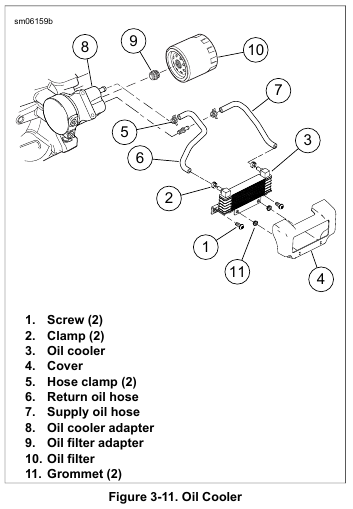
    3. See Figure 3-11. Pull out on the bottom of the oil cooler cover (4) to disengage the lower retaining pins, then pull up and remove cover from oil cooler.

    4. Remove screws (1) securing the oil cooler (3) to the frame.

    5. Slide clamps (5) down the oil hoses (6, 7). Disconnect hoses from the oil cooler adapter (8).

    6. Remove the oil cooler.

    7. Inspect oil cooler for dirt, debris and damage.

    8. To remove hoses from the oil cooler, cut clamps (2).


  • 2015 Touring – TROUBLESHOOTING – DIAGNOSING SMOKING ENGINE OR HIGH OIL CONSUMPTION

    Perform both a compression test and a cylinder leakage test. See 3.8 TROUBLESHOOTING, Compression Test and 3.8 TROUBLESHOOTING, Cylinder Leakdown Test. If further testing is needed, remove suspect head(s) and inspect for the following:

    Check Prior to Cylinder Head Removal
    1. Oil level too high.
    2. Oil carryover.
    3. Breather hose restricted.
    4. Restricted oil filter.

    Check After Cylinder Head Removal
    1. Oil return passages for clogging.
    2. Valve guide seals.
    3. Valve guide to valve stem clearance.
    4. Gasket surface of both head and cylinder.
    5. Cylinder head casting porosity allowing oil to drain into combustion chamber.
    6. O-ring damaged or missing from oil pump/crankcase junction.
    7. If the above checks do not reveal the cause, remove the cylinder to inspect for excess piston ring wear. Also verify
    the piston ring gaps are properly staggered.


  • 2015 Touring – TROUBLESHOOTING – CYLINDER LEAKDOWN TEST

    NOTE

    On vehicles with automatic compression release (ACR), verify the ACRs are closed for this test. Perform the test with the ignition/light switch in the OFF position.

    The cylinder leakdown test will help pinpoint leaking valves, worn, damaged or stuck piston rings and blown head gaskets.
    The cylinder leakage tester applies compressed air to the cylinder at a controlled pressure and volume. It then measures the percent of leakage from the cylinder.

    Use the CYLINDER LEAKDOWN TESTER (Part No. HD-35667-A). Follow the specific instructions supplied with the tester.

    The following are some general instructions that apply to Harley-Davidson V-twin engines:
    1. Run motorcycle until engine is at normal operating temperature. Stop engine.

    2. Disconnect spark plug wires. Clean around plug base and remove plugs.

    3. Rotate crankshaft until piston in the cylinder being tested is at top dead center (TDC) of compression stroke (both
    valves closed) during the test.

    4. Engage transmission in highest gear and lock the rear brake. This prevents the engine from turning over when
    air pressure is applied to the cylinder.

    NOTE

    Before performing the cylinder leakdown test, verify the tester it self is free from leakage. Apply a soap solution around all tester fittings. Connect cylinder leakdown tester to compressed air source. Look for any bubbles that indicate leakage from the tester.

    5. Following the manufacturer’s instructions, perform a cylinder leakdown test on the front cylinder. Make a note of the percent of leakage. Leakage greater than 10 percent indicates internal engine problems.

    6. Listen for air leaks at throttle body, exhaust pipe and head gasket. Air escaping through the throttle body indicates a leaking intake valve. Air escaping through the exhaust pipe indicates a leaking exhaust valve.

    NOTE

    If air is escaping through valves, verify that piston is still at TDC or check for correct pushrod length.

    7. Repeat procedure on rear cylinder.

  • 2015 Touring – TROUBLESHOOTING – COMPRESSION TEST

    A compression test can help determine the source of cylinder leakage. Use CYLINDER COMPRESSION GAUGE (Part No. HD-33223-1) with a screw-in type adapter.

    NOTE

    All Twin Cam engines use a 12 mm adapter with the compression gauge.
    1. Run motorcycle until engine is at normal operating temperature. Stop engine.

    2. Disconnect spark plug wires. Clean around plug base and remove plugs.

    3. Remove air cleaner. See 4.5 AIR CLEANER ASSEMBLY.

    4. Disconnect TCA connector [211] from the induction module.

    NOTE

    Never use a metal object to hold the throttle plate open.
    Damage to the throttle plate or throat of the induction module may result.

    5. Insert a 0.75 in (19 mm) diameter by approximately 12 in (305 mm) long wooden or nylon dowel to hold the throttle valve open.

    6. Connect compression tester to front cylinder per manufacturer’s instructions.

    7. Make sure transmission is in neutral. Crank engine continuously through five to seven full compression strokes and note gauge readings at the end of the first and last compression strokes. Record test results.

    8. Disconnect both ACRs and repeat test.

    9. Connect ACRs.

    10. Repeat tests on rear cylinder.

    11. Hold throttle valve open and remove dowel. Connect TCA connector [211] when tests are complete.

    12. Clear codes when test is complete.

    13. Install the air cleaner. See 4.5 AIR CLEANER ASSEMBLY.

    14. Refer to Table 3-28. If the final readings are within specifications and do not indicate more than a 10 percent variance between cylinders, compression is considered normal. If compression does not meet specifications, refer to
    Table 3-29 for possible causes.

    15. If readings do not meet specifications, inject approximately 1/2 oz (15 ml) engine oil into each cylinder and repeat the compression tests on both cylinders. Readings that are considerably higher during the second test indicate worn piston rings.

    16. Install the spark plugs and tighten to 12-18 ft-lbs (16.3-24.4 Nm). Connect spark plug wires.


  • 2015 Touring – TROUBLESHOOTING – DIAGNOSING VALVE TRAIN NOISE

    1. With engine and oil at normal operating temperature, check oil pressure at 2000 rpm. If oil pressure is above 50 psi (345 kPa) or below 5 psi (34 kPa), inspect the following for restrictions or blockage:
    a. Oil pump
    b. Crankcase passages
    c. Oil hoses

    2. Repair or replace parts as necessary.

    3. If oil is not reaching the hydraulic lifters, remove and inspect. See 3.21 PUSHRODS, LIFTERS AND COVERS,
    Lifter Inspection. Clean lifter bore of all foreign material. Replace hydraulic lifter if required.

    4. Inspect pushrod, lifter and lifter block for proper fit and unusual wear. Replace parts as necessary.

    5. Visually inspect camshaft lobes for abnormal wear.

    6. Check cam chain tensioning shoe for wear.

    7. Remove cylinder head and rocker box assemblies. Check rocker arm end play and check for binding. Inspect valve
    stems for scuffing and check stem to guide clearance. Check valve seats for signs of looseness or shifting.

    8. Grind valves and valve seats. See 3.22 CYLINDER HEAD, Valve and Seat Refacing.

  • 2015 Touring – OIL PRESSURE – CHECKING OIL PRESSURE

    Check operating oil pressure as follows:
    1. Verify engine oil is at the proper level. See 1.6 ENGINE OIL AND FILTER.

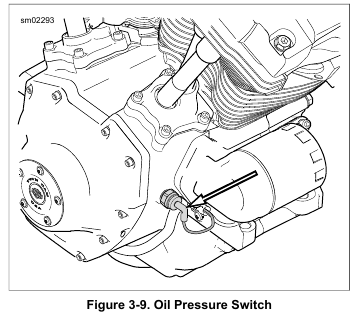
    2. See Figure 3-9. Remove oil pressure switch from crankcase. See 7.25 OIL PRESSURE SWITCH OR SENDER.

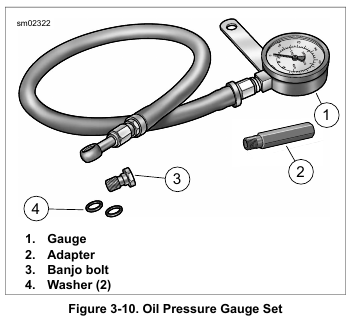
    3. See Figure 3-10. Install OIL PRESSURE GAUGE SET (Part No. HD-96921-52D).
    a. Hand-tighten adapter (2) in oil pressure switch mounting hole.
    b. Assemble banjo bolt (3), washer (4), oil pressure gauge (1), banjo fitting and second washer onto adapter. Hand-tighten.

    4. Run motorcycle until engine is at normal operating temperature.

    NOTE
    Engine oil should be at normal operating temperature, 230 °F (110 °C), for an accurate reading.

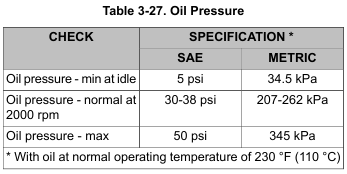
    5. Oil pressure should be within specifications. Refer to Table 3-27.

    6. See 1.26 TROUBLESHOOTING if readings are not within specification.

    7. Stop engine. Remove oil pressure gauge assembly.

    8. Install oil pressure switch. See 7.25 OIL PRESSURE SWITCH OR SENDER.


  • 2015 Touring – OIL PRESSURE – OIL PRESSURE INDICATOR LAMP

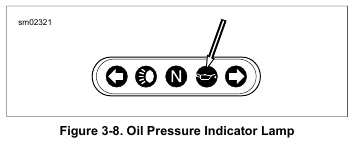
    See Figure 3-8. The red OIL PRESSURE indicator lamp illuminates to indicate improper circulation of the engine oil. The lamp illuminates when the ignition is first turned on (before the engine is started), but should extinguish once the engine is running.

    If the oil pressure indicator lamp remains lit, always check the oil supply first. If the oil supply is normal and the lamp is still lit, stop the engine at once and do not ride further until the trouble is located and the necessary repairs are made. Failure to do so may result in engine damage.
    (00157a)

    If the indicator lamp does not extinguish, it may be caused by low oil level or diluted oil supply. In freezing weather, the oil feed and return lines can clog with ice or sludge. Other conditions that may cause the lamp to remain lit are:
    • Faulty lamp wiring
    • Faulty oil pressure sending unit
    • Damaged oil pump
    • Plugged oil filter element
    • Incorrect oil viscosity for the operating temperature
    • Fractured or weak spring in the oil pressure relief valve
    • Incorrectly installed O-rings in the engine

    To troubleshoot the problem, always check the engine oil level first. If the oil level is OK, determine if oil returns to the oil pan.
    If oil does not return, shut off the engine until the problem is located and corrected.


  • 2015 Touring – BREATHER OPERATION – GENERAL

    The crankcase breather system relieves crankcase pressure produced by the downstroke of the pistons. Crankcase vapors are then directed into the intake air stream to be burned during normal combustion. Burning crankcase vapors eliminates the pollutants normally discharged from the crankcase.

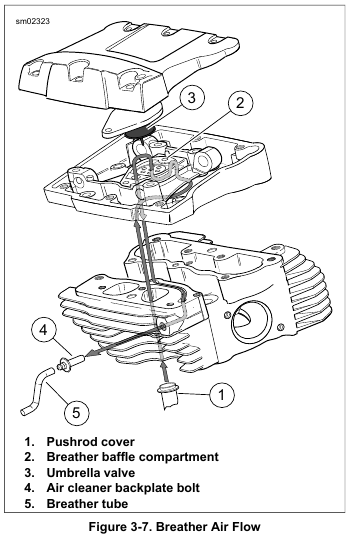
    See Figure 3-7. As pistons push downward, displaced air in the crankcase is vented through the crankshaft roller bearing into the cam compartment. The air then flows up the pushrod covers (1) into the rocker housing. The moving air absorbs a small amount if oil vapor as it travels through the engine.

    The oil/air vapor rushes under the rocker arm support plate and passes through an opening at the bottom of the plate to enter the breather baffle compartment (2).

    In the baffle compartment, the flow of air passes upward through the oil filter gauze, where the oil is removed from the air. Two pin holes in the rocker arm support plate allow the separated oil to drain back into the crankcase.

    Passing through the oil filter gauze, the vapor passes through the umbrella valve (3) into the breather compartment. The umbrella valve only allows air to be vented one way.

    In the breather compartment, air flows downward through holes aligned in the breather baffle, rocker arm support plate and rocker housing. Exiting the rocker housing, air enters a passageway cast into the top of the cylinder head. Proper orientation of the rocker housing gasket is critical for effective sealing of this passageway.

    Air flows through the cylinder head passageway and through a passage in the air cleaner backplate bolt (4). It passes through a breather tube (5) into the air filter element. It then joins with the intake air stream and is burned during normal combustion.

    NOTE

    Always connect breather tubes. Loose or detached tubes vent crankcase gases into the atmosphere which violates emissions standards.

  • 2015 Touring – OIL PUMP OPERATION – OPERATION

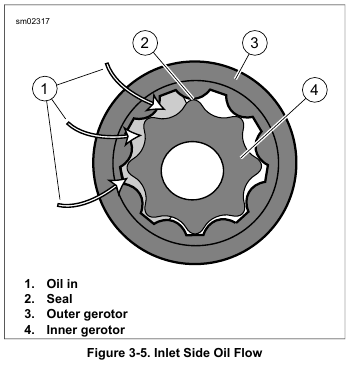
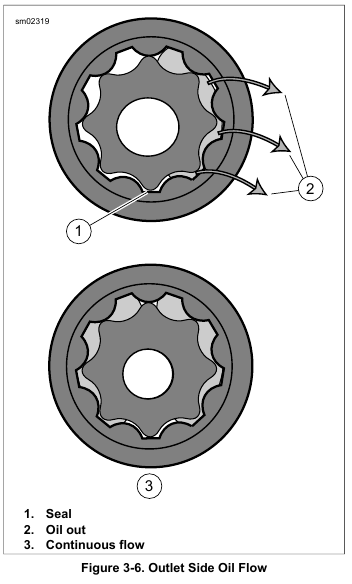
    The oil pump is driven by the crankshaft. The inlet and outlet sides of the pump are sealed by the tips and lobes of the inner and outer gerotors. This prevents oil on the outlet side (high pressure) from being transferred to the inlet side.

    See Figure 3-5. As the gerotors rotate, the cavity volume increases between the inner and outer gerotors on the inlet side of the pump. This creates a vacuum causing oil to be drawn in. The cavity increases until the volume is equivalent to that of the missing tooth on the inner gerotor.

    See Figure 3-6. As the oil moves to the outlet side of the pump, the cavity decreases in volume. This forces pressurized oil out the discharge port. In operation, the gerotors provide a continuous flow of oil.

  • 2015 Touring – OIL PUMP OPERATION – GENERAL

    See Figure 3-4. The oil pump has two gerotor gear sets driven by the crankshaft.

    • The feed gerotor set distributes oil to the engine.
    • The scavenge gerotor set draws oil from the cam and flywheel compartments and returns it to the oil pan.

    Each gerotor gear set has an inner and outer gerotor. The inner and outer gerotors have fixed centers that are slightly offset to one another. Also, the inner gerotor has one less tooth.