Author: Sam

  • 2015 Touring – CRANKSHAFT POSITION SENSOR (CKP) – REMOVAL

    1. Remove main fuse. See 7.3 SYSTEM FUSES AND RELAYS.

    NOTE

    CKP sensor connector is fixed to front caddy at bottom of lower frame crossmember.

    2. Push connector to the right to detach from caddy T-stud.

    3. Separate connector.

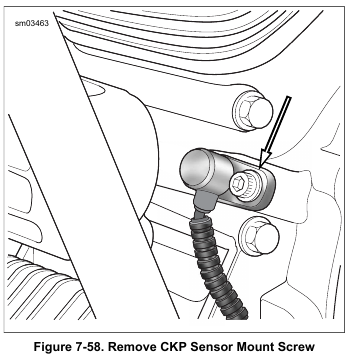
    4. See Figure 7-58 and Figure 7-59. Remove screw to free CKP sensor. Pull sensor from bore.

  • 2015 Touring – CRANKSHAFT POSITION SENSOR (CKP) – GENERAL

    The crank position sensor (CKP) is a variable reluctance (VR) sensor. It generates an AC signal by sensing the passing of the 30 teeth machined in the left side flywheel. Two consecutive teeth are missing in the flywheel to establish a reference point. The CKP sends a signal to the electronic control module which references engine position (TDC) and engine speed.

    NOTE

    CKP sensor connector is not serviceable. Replace the entire assembly if it fails.

  • 2015 Touring – ACCESSORY SWITCHES – NACELLE SWITCHES

    Removal

    1. Remove the nacelle half containing the switch to be replaced. See 2.47 HEADLAMP NACELLE: ROAD KING MODELS.

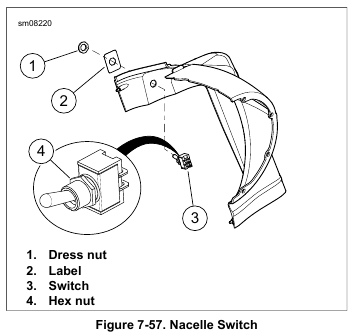
    2. See Figure 7-57. Remove dress nut (1).

    3. Remove switch (3).

    Installation

    1. See Figure 7-57. Install the switch:
    a. Turn hex nut (4) down against switch body.
    b. Verify label (2) is in place.
    c. Put the switch (3) in place.
    d. Install the dress nut (1) 1.5-2.5 turns.

    2. Turn hex nut (4) against the inside of the nacelle. Tighten to 9-15 in-lbs (1.0-1.7 Nm).

    3. Install the nacelle half. See 2.47 HEADLAMP NACELLE: ROAD KING MODELS.

    4. Operate switch to verify repair.


  • 2015 Touring – ACCESSORY SWITCHES – FRAME MOUNTED FAIRING MODELS

    Removal

    NOTE

    Maximum current rating for each switch is 2A.

    1. Remove instrument bezel. See 2.40 INSTRUMENT BEZEL: FRAME MOUNTED FAIRING MODELS.

    2. See Figure 7-56. Remove two screws (3). Remove switch module or hole plug (1).

    NOTES

    • Record positions of switches and plunger types for assembly.
    • The switch module assembly can house either active switch plungers or static plungers depending on equipment. Active plungers can be push-push type or momentary. All are removed and installed in the same manner.
    • See Figure 7-55. Lock (3) extracts approximately 1/8 in (3.2 mm) and does not come free from housing.

    3. Gently pry lock (3) outward to release switch plunger (2).

    4. Remove switch plunger from switch module.

    Installation

    1. See Figure 7-55. Push plunger (2) into switch module.
    Push lock (3) into place.

    NOTE

    Verify that switches are located as recorded during disassembly.

    2. See Figure 7-56. Secure switch module (1) with two screws (3). Tighten to 12-17 in-lbs (1.4-1.9 Nm).

    3. Install instrument bezel. See 2.40 INSTRUMENT BEZEL: FRAME MOUNTED FAIRING MODELS.

    4. Operate all switches to verify repair.


  • 2015 Touring – ACCESSORY SWITCHES – FORK MOUNTED FAIRING MODELS

    Removal

    NOTE

    Maximum current rating for each switch is 2A.

    1. Remove dash panel. See 2.38 DASH PANEL: FORK MOUNTED FAIRING MODELS.

    2. See Figure 7-54. Remove two screws (3). Remove switch module (2) or hole plug (1).

    NOTES
    • Record positions of switches and plunger types for assembly.
    • The switch module assembly can house either active switch plungers or static plungers depending on equipment. Active plungers can be push-push type or momentary. All are removed and installed in the same manner.
    • See Figure 7-55. Lock (3) extracts approximately 1/8 in (3.2 mm) and does not come free from housing.

    3. Gently pry lock (3) outward to release switch plunger (2).

    4. Remove switch plunger from switch module.

    Installation

    1. See Figure 7-55. Push plunger (2) into switch module.
    Push lock (3) into place.

    NOTE

    Verify that switches are located as recorded during disassembly.

    2. See Figure 7-54. Secure switch module to dash panel with two screws (3). Tighten to 12-17 in-lbs (1.4-1.9 Nm).

    3. Install dash panel. See 2.38 DASH PANEL: FORK MOUNTED FAIRING MODELS.

    4. Operate all switches to verify repair.


  • 2015 Touring – IGNITION SWITCH AND FORK LOCK – ROAD KING MODELS

    Ignition/Light Key Switch: Removal

    1. Remove main fuse. See 7.3 SYSTEM FUSES AND RELAYS.

    2. Remove seat. See 2.30 SEAT.

    3. Remove console. See 4.6 FUEL TANK, Console.

    4. See Figure 7-52. Disconnect ignition switch connector [33]. Release ignition switch conduit from plastic clip, if necessary.

    5. Remove four screws to release ignition switch from console.

    Ignition/Light Key Switch: Installation

    1. See Figure 7-52. Install ignition switch. Tighten to 25-35 in-lbs (2.8-3.9 Nm) in a crosswise pattern.

    2. Connect ignition connector [33]. Capture ignition switch conduit in plastic clip, if removed.

    3. Using caution to avoid pinching wire harness and vent tube, install console. See 4.6 FUEL TANK, Console.

    4. Install seat. See 2.30 SEAT.

    5. Install main fuse. See 7.3 SYSTEM FUSES AND RELAYS.

    Fork Lock: Removal

    1. Remove handlebar clamp shroud. See 2.47 HEADLAMP NACELLE: ROAD KING MODELS.

    2. Start acorn nuts on both the left and right side fork bracket studs to keep halves of headlamp nacelle on motorcycle.

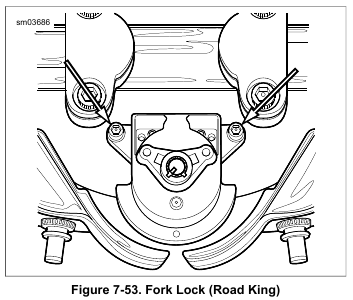
    3. US models: See Figure 7-53. Remove two screws (with flat washers).

    4. International models: Remove two break-away screws:
    a. Center punch the top of each break-away screw.
    b. Use a 1/8 inch left-handed drill bit. Set the drill to REVERSE and use to spin out the break-away screws.

    NOTE

    If the above method fails:
    • Use a 3/16 inch bit to carefully drill off heads of break-away screws.
    • Use pliers to remove remainder of screws once the switch is removed.

    5. Remove fork lock assembly from upper fork bracket bore.

    Fork Lock: Installation

    1. See Figure 7-53. Position fork lock assembly into bore of upper fork bracket.

    2. US models: Install two screws (with flat washers). Tighten to 36-60 in-lbs (4.1-6.8 Nm).

    3. International models:
    a. Verify that the threads in the upper fork bracket are clean and in good condition. Dirty and/or damaged threads may cause the heads of the break-away screws to snap off before the fork lock is properly tightened.

    NOTE

    Do not lose heads of break-away screws in motorcycle. Vibration may cause captured heads to scratch finished surfaces, chafe wires or cause other damage.

    b. Install two new break-away screws (with flat washers).
    Tighten until heads snap off.

    4. Install handlebar clamp shroud. See 2.47 HEADLAMP
    NACELLE: ROAD KING MODELS.


  • 2015 Touring – IGNITION SWITCH AND FORK LOCK – FAIRING MODELS

    Removal

    1. Remove main fuse. See 7.3 SYSTEM FUSES AND RELAYS.

    2. Remove the ignition switch knob:
    a. Insert the ignition switch key and turn to the UNLOCK position. Leave the key installed.
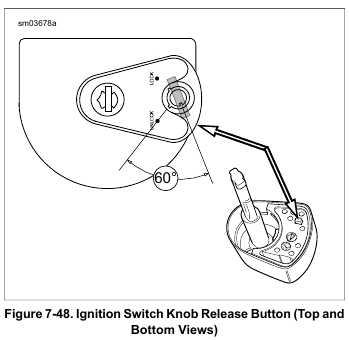
    b. See Figure 7-48. Rotate the knob to FORK LOCK.
    c. Press and hold the release button at bottom (left side) of the knob, and turn key 60 degrees counterclockwise.
    d. Lift knob to remove. Spring will drop out of bore at underside of knob when removed.

    NOTE

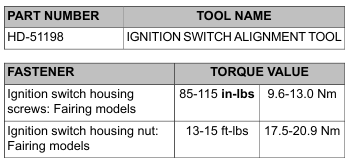
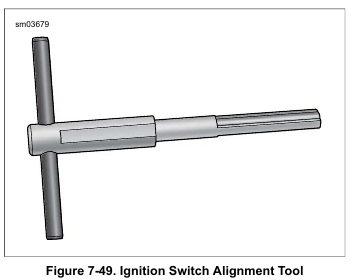
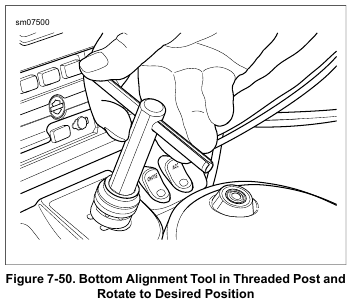
    See Figure 7-50. Use IGNITION SWITCH ALIGNMENT TOOL (Part No. HD-51198) to move the switch to other positions as required. Insert tool until bottom of handle contacts top of ignition switch. Rotate handle to the selected position.

    3. Fork mounted fairing models:
    a. Remove nut and collar from ignition switch.
    b. Remove dash panel. See 2.38 DASH PANEL: FORK MOUNTED FAIRING MODELS.

    4. Frame mounted fairing models: Remove instrument bezel. See 2.40 INSTRUMENT BEZEL: FRAME MOUNTED FAIRING MODELS.

    5. Disconnect ignition switch connector [33].

    6. Domestic models: Remove two screws and flat washers securing ignition switch assembly.

    Always wear proper eye protection when drilling or grinding. Flying debris could cause serious eye injury. (00402e)

    7. HDI models: Remove two break-away screws:
    a. Rotate inner fairing to access screws. See 7.3 SYSTEM FUSES AND RELAYS.
    b. Use a center punch to make a pilot hole at the top of each break-away screw.
    c. Use a 1/8 inch left handed bit in drill. Set the drill to REVERSE and use to spin out the screws.

    NOTE

    If the above method fails, use a 3/16 inch bit to drill off heads of the screws to remove switch. Use pliers to remove remainder of screws from upper fork bracket.

    8. Remove ignition switch.

    Installation

    1. Place ignition switch into position.

    2. Domestic models: Install two screws and flat washers.
    Tighten to 85-115 in-lbs (9.6-13.0 Nm).

    3. HDI models:
    a. Verify that the threads in the upper fork bracket are clean and in good condition. Dirty and/or damaged threads may cause the heads of the break-away screws to snap off before the switch housing is properly tightened.

    NOTE

    Use care to avoid losing heads of break-away screws in motorcycle. Vibration may cause captured heads to scratch finished surfaces, chafe wires or cause other damage.

    b. Install two new break-away screws and flat washers.
    Tighten until heads snap off.

    c. Rotate inner fairing into position and secure. See 7.3 SYSTEM FUSES AND RELAYS.

    4. Install ignition switch connector.

    5. Fork mounted fairing models:
    a. Install dash panel. See 2.38 DASH PANEL: FORK MOUNTED FAIRING MODELS.
    b. Install collar and nut. Tighten to 13-15 ft-lbs (17.5-20.9 Nm).

    6. Frame mounted fairing models: Install instrument bezel.
    See 2.40 INSTRUMENT BEZEL: FRAME MOUNTED FAIRING MODELS.

    7. Place spring into bore at underside of knob.

    8. Install ignition switch knob:
    a. See Figure 7-48. Verify that button at bottom of knob is pressed and key is turned 60 degrees counterclockwise of the UNLOCK position.
    b. With the knob pointing toward the FORK LOCK posi-
    tion, insert shaft into ignition switch.
    c. Hold the knob down and the turn key clockwise to the
    UNLOCK position. An audible “click” is heard when
    knob and switch are properly engaged.
    d. Release the knob. Rotate through all four switch
    positions to verify proper operation. If knob does not
    install properly, proceed to next step.

    9. Knob was removed in the ACCESS position or switch was moved out of the FORK LOCK position:
    a. See Figure 7-50. Insert alignment tool until bottom of handle contacts top of ignition switch. While holding front forks at the left fork stop, rotate handle of tool counterclockwise until fork locks.
    b. Remove tool. Install knob.
    c. If knob does not install properly, proceed to next step.

    10. Detent and switch position lugs are misaligned:
    a. Insert knob into ignition switch and rotate until it drops into the partially installed position. Take note whether it is pointing toward the rear, or to ACCESS, IGNITION or OFF.
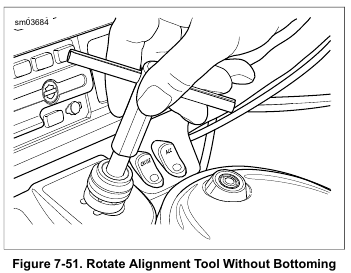
    b. See Figure 7-51. Remove knob. Insert and hold alignment tool so that the bottom of the handle is approximately 0.50-0.75 in (12.7-19.1 mm) from the top of the ignition switch.
    c. Rotate alignment tool counterclockwise the number of positions needed to get to FORK LOCK.
    d. Install knob.

    11. Install main fuse. See 7.3 SYSTEM FUSES AND RELAYS.


  • 2015 Touring – TURN SIGNAL LAMPS – REAR TURN SIGNAL LAMPS BRACKET

    Removal: All but FLHX/S, FLTRX/S

    1. Remove circuit board and chrome base. See 7.11 REAR LIGHTING.

    2. Remove rear turn signal lamps from bracket. See 7.14 TURN SIGNAL LAMPS, Rear Turn Signal Lamp.

    3. If equipped with license plate lamp on turn signal bracket, remove terminals from license plate lamp connector. See A.21 TYCO 070 MULTILOCK UNSEALED CONNECTOR.

    4. Remove two screws to free rear turn signal lamps bracket from rear fender.

    5. Remove two screws to free license plate bracket and lamp, if equipped.

    Installation: All but FLHX/S, FLTRX/S

    1. Install license plate bracket and lamp, if equipped, onto turn signal bracket. Tighten to 60-90 in-lbs (6.8-10.2 Nm).

    2. Apply one drop of LOCTITE 271 HIGH STRENGTH THREADLOCKER (red) to screws.

    3. Install rear turn signal lamps bracket. Tighten to 84-144 in-lbs (9.5-16.3 Nm).

    4. If equipped with license plate lamp on turn signal bracket, route wires through hole in fender and install terminals into license plate lamp connector. See A.21 TYCO 070 MULTILOCK UNSEALED CONNECTOR. Also refer to Table 7-16.

    5. Install rear turn signal lamps in bracket. See 7.14 TURN SIGNAL LAMPS, Rear Turn Signal Lamp.

    6. Install chrome base and circuit board assembly. See 7.11 REAR LIGHTING.

    Removal:FLHX/S, FLTRX/S

    1. Models with tail lamp:
    a. Remove circuit board and chrome base. See 7.11 REAR LIGHTING.
    b. See Figure 7-45. Release turn signal lamp harnesses (4) from cable clips.
    c. Remove terminals from license plate lamp connector. See A.21 TYCO 070 MULTILOCK UNSEALED CONNECTOR.

    2. Models without tail lamp:
    a. See Figure 7-46. Disconnect turn signal connector (3) from rear fascia lamp.
    b. Release harness from J-clamp (2) located above fascia lamp.
    c. Push grommet (1) rearward out of hole in fender.

    3. Remove two screws to release rear turn signal lamps bracket. Remove bracket and harnesses

    4. Remove screws to release license plate bracket and lamp from turn signal bracket.

    Installation: FLHX/S, FLTRX/S

    1. Install license plate lamp and bracket onto turn signal bracket. Tighten to 60-90 in-lbs (6.8-10.2 Nm).

    2. Models with tail lamp: Feed socket housings of left and right rear turn signal lamps and license plate wire terminals through respective holes to inboard side of fender.

    3. Models without tail lamp:
    a. See Figure 7-47. Install grommet (1) and orient as shown.
    b. Route harness through hole in fender and seat grommet in hole.

    4. Apply one drop of LOCTITE 271 HIGH STRENGTH THREADLOCKER (red) to screws.

    5. Install rear turn signal lamps bracket. Tighten to 84-144 in-lbs (9.5-16.3 Nm).

    6. Models with tail lamp:
    a. Install terminals into license plate lamp connector.
    See A.21 TYCO 070 MULTILOCK UNSEALED CONNECTOR. Also refer to Table 7-16.
    b. Install chrome base and circuit board assembly. See 7.11 REAR LIGHTING.

    7. Models without tail lamp:
    a. See Figure 7-46. Install connector (3).
    b. Secure harness in J-clamp (2) and under tab on end of fascia lamp.


  • 2015 Touring – TURN SIGNAL LAMPS – REAR TURN SIGNAL LAMP

    Removal: All but FLHX/S, FLTRX/S

    1. Remove saddlebag as necessary. See 2.31 SADDLEBAGS.

    2. See Figure 7-42. Remove and disconnect tail lamp assembly from chrome base.

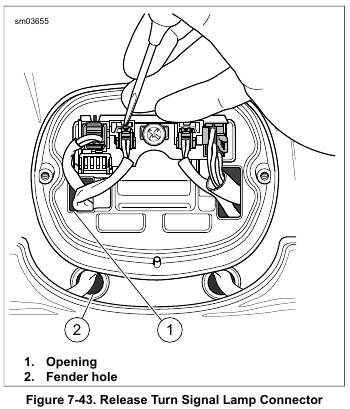
    3. See Figure 7-43. Disconnect turn signal lamp connector (2-place Multilock). Use a pick or small screwdriver to press latch.

    4. Feed connector to inboard side of rear fender.

    5. Release harness from cable clip inside fender.

    6. Draw out harness and connector through fender hole (2).

    7. Draw connector through channel on inboard side of rear turn signal lamp bracket, so that length of conduit hangs below turn signal lamp.

    8. Remove two screws to release turn signal lamp assembly.
    Use a LONG SHANK BALL END SOCKET (Part No. Snapon FABL5) or equivalent through the channel in the bracket.

    9. Remove terminals from connector. See A.21 TYCO 070 MULTILOCK UNSEALED CONNECTOR.

    Installation:All but FLHX/S, FLTRX/S

    1. Place new turn signal lamp assembly next to discarded unit and cut wires to proper length.

    2. Crimp new terminals onto turn signal lamp wires. Install terminals into connector housing. Refer to Table 7-13. See A.21 TYCO 070 MULTILOCK UNSEALED CONNECTOR.

    3. Install turn signal lamp assembly. Tighten to 30-50 in-lbs (3.4-5.6 Nm).

    4. See Figure 7-43. Route connector through channel in bracket, then through fender hole (2).

    5. Capture harness in cable clip under fender.

    6. Feed connector through opening (1) in chrome base.

    7. See Figure 7-42. Connect turn signal harness connector (1 or 2).

    8. Connect tail lamp connector (3). Verify that tail lamp harness is positioned outboard of the rear fender tip lamp and left turn signal lamp harnesses.

    9. Install tail lamp. Tighten to 20-24 in-lbs (2.3-2.7 Nm).

    Be sure that all lights and switches operate properly before operating motorcycle. Low visibility of rider can result in death or serious injury. (00316a)

    10. Test lamp operation.

    11. Install saddlebag.

    Removal: FLHX/S, FLTRX/S

    NOTES

    • This procedure covers replacement of the rear turn signal lamp reflector/ isolator assembly only.

    • Individual LEDs cannot be replaced. Replace assembly upon failure. See 7.14 TURN SIGNAL LAMPS, Rear Turn Signal Lamps Bracket.

    1. Models with tail lamp:
    a. Remove circuit board and chrome base. See 7.11 REAR LIGHTING.
    b. Remove terminals from turn signal lamp connector housing. See A.21 TYCO 070 MULTILOCK UNSEALED CONNECTOR.
    c. Release harness from cable clip inside fender.
    d. Draw harness and terminals through hole to outboard side of fender. Proceed with reflector/isolator removal.

    2. Models without tail lamp:
    a. Remove turn signal lamps bracket. See 7.14 TURN SIGNAL LAMPS, Rear Turn Signal Lamps Bracket.
    b. Remove grommet from harness.
    c. Remove license plate bracket.
    d. Remove screws securing license plate lamp.
    e. Remove terminals from connector housing. See A.11 DELPHI MICRO 64 SEALED CONNECTORS.
    f. Pull wires through main conduit.

    Installation: FLHX/S, FLTRX/S

    1. Models with tail lamp:
    a. Install new terminals onto wires. See A.21 TYCO 070 MULTILOCK UNSEALED CONNECTOR.
    b. Feed terminals through hole to inboard side of fender.
    c. Install terminals into connector housing. Refer to Table 7-13. See A.21 TYCO 070 MULTILOCK UNSEALED CONNECTOR.
    d. Capture harness in cable clip inside fender.
    e. Install chrome base and circuit board assembly. See 7.11 REAR LIGHTING.

    2. Models without tail lamp:
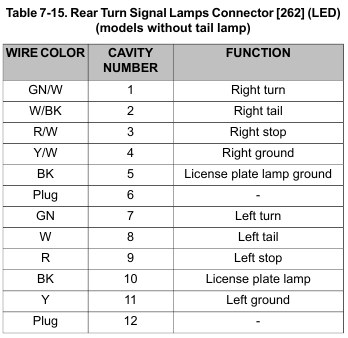
    a. Feed wires through main conduit. Install new terminals and install in connector housing. Refer to Table 7-14 or Table 7-15. See A.11 DELPHI MICRO 64 SEALED CONNECTORS.
    b. Route both turn signal lamp harnesses under license plate lamp area. Install license plate lamp and license plate bracket. See 7.14 TURN SIGNAL LAMPS, Rear Turn Signal Lamps Bracket.
    c. Install turn signal lamps bracket. See 7.14 TURN SIGNAL LAMPS, Rear Turn Signal Lamps Bracket.

    Be sure that all lights and switches operate properly before operating motorcycle. Low visibility of rider can result in death or serious injury. (00316a)

    3. Test lamp operation.

    Lamp Repair

    NOTE

    LED type lamps are not serviced separately. Replace the light bar assembly.

    1. Remove lens and bulb.

    2. Push grommet into lamp housing. Lubricate grommet with glass cleaner, if necessary.

    3. See Figure 7-44. Insert a right angle pick or a small hex key from inside the bulb socket through hole (4). Pull reflector from lamp.

    4. Remove rubber isolator (3).

    5. Install rubber isolator.

    6. Place new reflector assembly next to discarded unit and cut wires to proper length.

    7. Seat reflector assembly in rubber isolator, aligning tab on reflector with slot in isolator.

    8. Feed wires through lens opening and out through hole in lamp housing.

    9. Install grommet in lamp housing. Lubricate grommet with glass cleaner, if necessary.

    10. Align tab on reflector with slot inside lamp. Use thumbs of both hands to apply even pressure around outer edge of reflector assembly until fully seated.

    11. Liberally apply dielectric grease to contacts in socket and at bottom of bulb. Install bulb and lens with slot at bottom of lamp.


  • 2015 Touring – TURN SIGNAL LAMPS – FRONT TURN SIGNAL LAMP

    Removal: Flat Lens Style

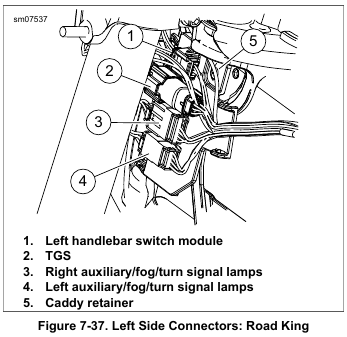
    1. See Figure 7-37. Remove headlamp assembly. See 7.9 HEADLAMP. Disconnect front turn signal lamps connector.

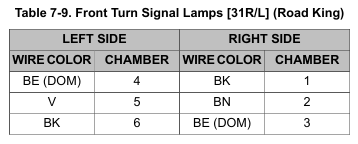
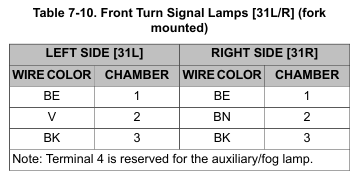
    2. Remove terminals from connector housing. Refer to Table 7-9 or Table 7-10. See A.17 JAE MX19 SEALED CONNECTORS.
    3. See Figure 7-36. Remove two screws to release turn signal lamp from mounting bracket.

    NOTE

    Make sure that chaser wire is of sufficient strength to pull terminals through conduit without breaking. Wire lengths must also be long enough that free ends are not lost in conduit when pulled.

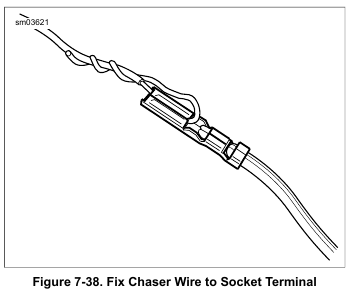
    4. See Figure 7-38. Obtain three equal lengths of strong flexible wire for use as chaser wires. Securely attach a chaser wire to terminal of each wire.

    5. Carefully pull wires to draw terminals through both sections of conduit. For best results, pull one wire at a time.

    6. Remove chaser wire from terminals.
    Installation: Flat Lens Style

    1. Lay old turn signal lamp next to new turn signal lamp and cut wires to length.

    2. Strip 3/16 in (4.8 mm) of insulation off wires and crimp on new terminals. See A.17 JAE MX19 SEALED CONNECTORS.

    3. Secure chaser wires to terminals. Carefully draw terminals back through conduit.

    4. Remove chaser wires.

    5. Install terminals into connector housing. Refer to Table 7-9 or Table 7-10. See A.17 JAE MX19 SEALED CONNECTORS.

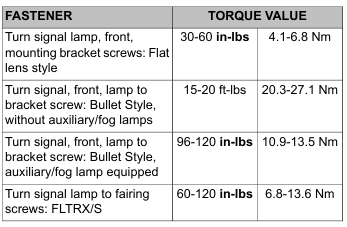
    6. See Figure 7-36. Start two screws to secure turn signal lamp to mounting bracket. Verify that conduit fits in slot at back of bracket and is not pinched. Tighten screws to 30-60 in-lbs (4.1-6.8 Nm).

    7. Connect front turn signal/auxiliary/fog lamp connector.

    8. See Figure 7-37. Secure anchor to fork stem nut lockplate.
    Install headlamp assembly. See 7.9 HEADLAMP.

    Be sure that all lights and switches operate properly before operating motorcycle. Low visibility of rider can result in death or serious injury. (00316a)

    9. Check operation of all lamps.
    Removal: Bullet Style, Fork Mounted

    1. Remove turn signal/auxiliary/fog lamp bracket. See 7.10 AUXILIARY/FOG LAMPS AND BRACKETS.

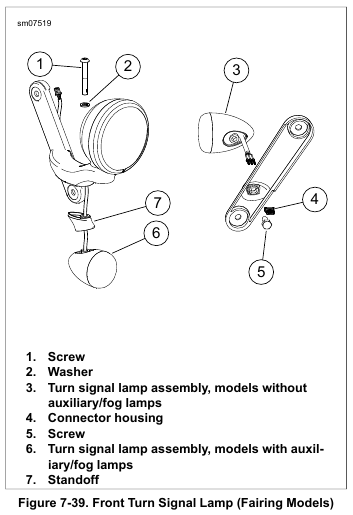
    2. See Figure 7-39. Remove terminals from connector housing (4). See A.17 JAE MX19 SEALED CONNECTORS.

    3. Remove screw (1 or 5). Remove lamp assembly from bracket.

    4. Remove reflector assembly:
    a. Separate mounting bracket from harness.
    b. Remove lens and bulb.
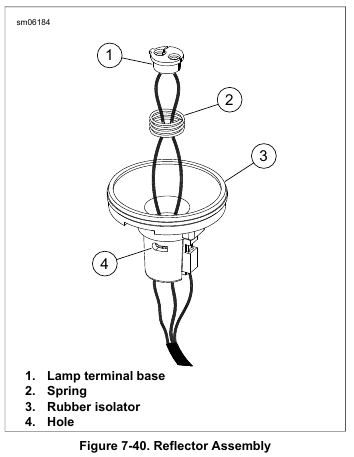
    c. See Figure 7-40. Insert a right angle pick or a small hex key from inside the bulb socket through hole (4). Pull reflector from lamp.
    d. Remove rubber isolator (3).
    Installation: Bullet Style, Fork Mounted

    1. Install reflector assembly:
    a. Seat reflector assembly in rubber isolator, aligning tab on reflector with slot in isolator.
    b. Feed wires through lens opening and out through unthreaded hole.
    c. Aligning tab on reflector with slot inside lamp, use thumbs of both hands and apply even pressure around outer edge of reflector assembly until fully seated.
    d. Liberally apply dielectric grease to contacts in socket and at bottom of bulb. Install bulb and lens with slot at bottom of lamp.
    e. Feed wires through hole in mounting bracket.

    2. See Figure 7-39. Install lamp on mounting bracket. Tighten to:
    a. Models without auxiliary/fog lamps: 15-20 ft-lbs (20.3-27.1 Nm).
    b. Models with auxiliary/fog lamps: 96-120 in-lbs (10.9-13.5 Nm).

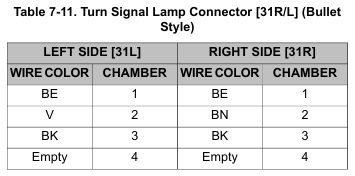
    3. Install terminals into connector housing as shown in Table 7-11. See A.17 JAE MX19 SEALED CONNECTORS.
    4. Install turn signal/auxiliary/fog lamp bracket. See 7.10 AUXILIARY/FOG LAMPS AND BRACKETS.

    Be sure that all lights and switches operate properly before operating motorcycle. Low visibility of rider can result in death or serious injury. (00316a)

    5. Check operation of all lamps.
    Removal: Bullet Style, Fairing Mounted

    1. Remove outer fairing. See 2.42 OUTER FAIRING AND WINDSHIELD: FRAME MOUNTED FAIRING MODELS.

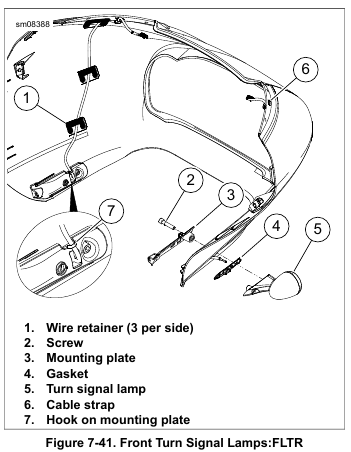
    2. See Figure 7-41. Cut cable strap (6). Remove wire retainers (1). Release wires from hook (7).

    3. Remove screw (2), mounting plate (3), gasket (4) and lamp (5).

    4. To remove reflector/isolator assembly:
    a. Remove terminals from connector housing. See A.17 JAE MX19 SEALED CONNECTORS.
    b. Separate lamp from mounting bracket.
    c. Remove lens and bulb.
    d. See Figure 7-40. Insert a right angle pick or a 7/64 in hex key through hole (4) and pull reflector from lamp.
    e. Remove isolator (3) from lamp if still installed.
    Installation: Bullet Style, Fairing Mounted

    1. Assemble front turn signal lamp:
    a. Seat reflector assembly in rubber isolator, aligning tab on reflector with slot in isolator.
    b. Feed wires through lens opening and out through non-threaded hole.
    c. Aligning tab on reflector with slot inside lamp, use thumbs of both hands and apply even pressure around outer edge of reflector assembly until fully seated.
    d. Liberally apply dielectric grease to contacts in socket and at bottom of bulb. Install bulb and lens with slot at bottom of lamp.
    e. Install lamp onto mounting bracket.
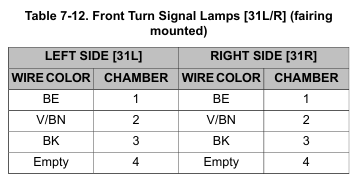
    f. Install terminals into connector housing as shown in Table 7-12. See A.17 JAE MX19 SEALED CONNECTORS.
    2. See Figure 7-41. Install mounting plate (3), gasket (4) and lamp (5). Secure with screw (2). Tighten to 60-120 in-lbs (6.8-13.6 Nm).

    3. Secure harness in hook (7) and route upwards.

    4. Clean all residual adhesive from retainer mounting areas.

    NOTE

    Place retainers (1) within bosses molded into the inside of the fairing.

    5. Secure with three new wire retainers (1) and cable strap (6).

    6. Install outer fairing. See 2.42 OUTER FAIRING AND WINDSHIELD: FRAME MOUNTED FAIRING MODELS.

    Be sure that all lights and switches operate properly before operating motorcycle. Low visibility of rider can result in death or serious injury. (00316a)

    7. Check operation of all lamps.