Author: Sam

  • 2015 Touring – HORN – INSPECTION

    If the horn fails to sound or does not sound satisfactorily, check for loose, frayed or damaged wires leading to horn terminal, discharged battery or corroded ground.

    The horn cannot be repaired or adjusted for tone. Only the mounting hardware is replaceable.


  • 2015 Touring – STOP LAMP SWITCHES – REAR STOP LAMP SWITCH

    Removal

    D.O.T. 4 brake fluid will damage painted and body panel surfaces it comes in contact with. Always use caution and protect surfaces from spills whenever brake work is performed. Failure to comply can result in cosmetic damage. (00239b)

    • If DOT 4 brake fluid contacts painted surfaces, IMMEDIATELY flush area with clear water.
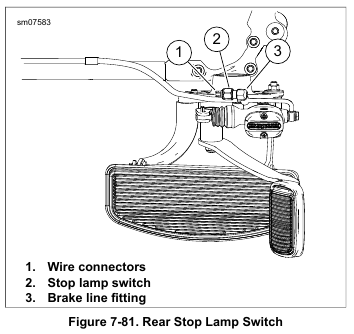
    1. See Figure 7-81. Remove rear brake master cylinder:
    a. Support front of engine.
    b. Remove screws securing front right engine mount end cap.
    c. Carefully pull off end cap mount with footboard, master cylinder and brake pedal attached. Allow to lay beside the vehicle.

    2. Remove stop lamp switch connectors (1).

    NOTE

    Wrap banjo fittings with pieces of lint-free shop towel to absorb any loss of brake fluid.

    3. Hold brake line fitting (3) and remove rear stop lamp switch (2).

    Installation

    1. Apply LOCTITE 565 THREAD SEALANT to rear stop lamp switch.

    2. See Figure 7-81. Install rear stop lamp switch (2) into rear brake line fitting (3).

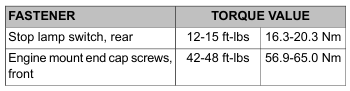
    3. Hold brake line fitting and tighten to 12-15 ft-lbs (16.3-20.3 Nm).

    4. Install rear brake master cylinder:
    a. Support front of engine.

    NOTE

    Confirm oil switch/sender wires are inboard of rubber mount.

    b. Remove screws securing front right engine mount end cap.
    c. Install stop lamp switch connectors (1).
    d. Install engine mount end cap. Tighten to 42-48 ft-lbs (56.9-65.0 Nm).

    5. Bleed brake system. See 2.18 BLEEDING BRAKES.

    Be sure that all lights and switches operate properly before operating motorcycle. Low visibility of rider can result in death or serious injury. (00316a)

    6. Verify tail lamp and stop lamp operation.


  • 2015 Touring – OIL PRESSURE SWITCH OR SENDER – INSTALLATION

    NOTE

    If reusing oil pressure switch or sender, apply LOCTITE 565 THREAD SEALANT to threads.

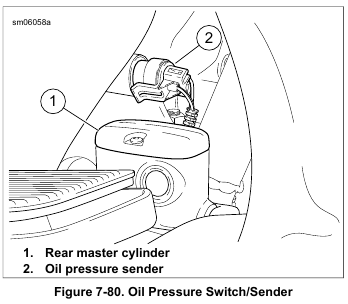
    1. See Figure 7-80. Start oil pressure switch or sender into crankcase bore. Tighten to 96-144 in-lbs (10.8-16.3 Nm).

    NOTE

    Make sure harness is routed inside front downtube.

    2. Connect harness.

    3. Test oil pressure switch/sender for proper operation and check for leaks.


  • 2015 Touring – OIL PRESSURE SWITCH OR SENDER – REMOVAL

    1. See Figure 7-80. Remove connector (2) from oil pressure switch or sender.

    2. Remove switch or sender from crankcase.


  • 2015 Touring – NEUTRAL SWITCH – INSTALLATION

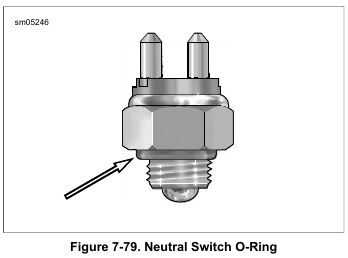
    1. See Figure 7-79. Inspect O-ring for damage. Replace as necessary. Lightly lubricate new O-ring with clean transmission oil before installation.

    2. Verify that transmission is in NEUTRAL.

    3. Install neutral switch in transmission case. Tighten to 120-180 in-lbs (13.6-20.3 Nm).

    NOTE

    The neutral switch is not polarity sensitive. Install connectors on either post.

    4. Install both connectors onto neutral switch posts.

    5. Verify proper operation of neutral switch.
    a. Turn ignition/light key switch to IGNITION.
    b. Verify that neutral indicator light illuminates.


  • 2015 Touring – NEUTRAL SWITCH – REMOVAL

    1. Place transmission in NEUTRAL.

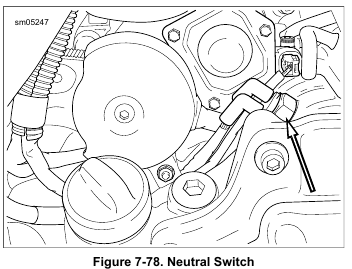
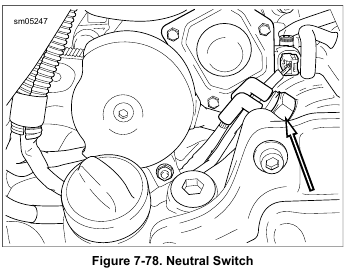
    2. See Figure 7-78. Remove two elbow connectors from neutral switch posts.

    3. Remove neutral switch from transmission case.


  • 2015 Touring – WHEEL SPEED SENSORS – REAR WHEEL SPEED SENSOR

    Removal

    NOTES

    • Always keep the wheel speed sensor (WSS) and ABS encoder bearing away from magnetic fields. Items such as magnetic parts trays, magnetic base dial indicators, alternator rotors, etc. will damage sensor.
    • Never pull WSS cable taut or use to retain wheel, axle or other components.

    1. Remove right saddlebag. See 2.31 SADDLEBAGS.

    2. Remove right side cover.

    3. Release rear WSS connector from anchor on right side battery tray. Disconnect connector.

    4. Rear WSS cable and rear brake hose are secured to the rear fork with two cable retainers. The sensor cable is additionally secured to the brake hose with a conduit clip.
    Free rear WSS cable from all three.

    5. Retract axle until rear WSS is free. See 2.5 REAR WHEEL.

    NOTE

    The WSS works in conjunction with the ABS encoder bearing installed in the wheel hub. If necessary, see 2.10 SEALED WHEEL BEARINGS for bearing removal and installation instructions.

    Installation

    NOTE

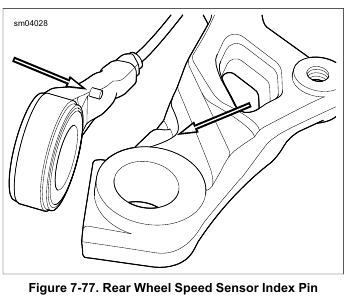
    Install WSS with index pin on the outboard side.

    1. See Figure 7-77. Hold new rear WSS in place with index pin outboard toward rear fork, and push axle through sensor, caliper bracket and right side of rear fork.

    2. Secure rear wheel. See 2.5 REAR WHEEL. Rotate rear WSS until index pin makes contact with caliper bracket at point shown in Figure 7-77.

    3. Route rear WSS cable forward along top of rear fork.

    4. Capture rear WSS cable and brake hose in rear cable clips on top of rear fork. Secure cable to brake hose with conduit clip placed 1.25 in. (31.8 mm) ahead of the rear brake hose crimp.

    5. Route cable to outboard right side of battery caddy. Connect pin and socket housings. Secure to anchor.

    6. Install right side cover.

    7. Install right saddlebag. See 2.31 SADDLEBAGS.


  • 2015 Touring – WHEEL SPEED SENSORS – FRONT WHEEL SPEED SENSOR (WSS)

    Removal

    NOTES

    • Always keep the wheel speed sensor (WSS) and ABS encoder bearing away from magnetic fields. Items such as magnetic parts trays, magnetic base dial indicators, alternator rotors, etc. will damage sensor.
    • Never pull WSS cable taut or use to retain wheel, axle or other components.

    1. Fairing models: Remove outer fairing. See 2.37 OUTER FAIRING AND WINDSHIELD: FORK MOUNTED FAIRING MODELS.

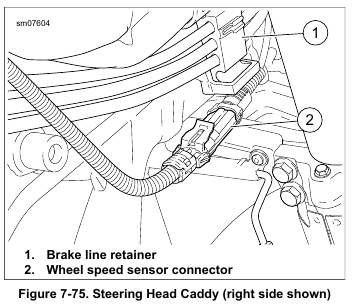
    2. See Figure 7-75. Separate sensor connector (2). Remove sensor cable from caddy.

    3. Release sensor cable from conduit clips and cut cable straps securing cable to brake hoses.

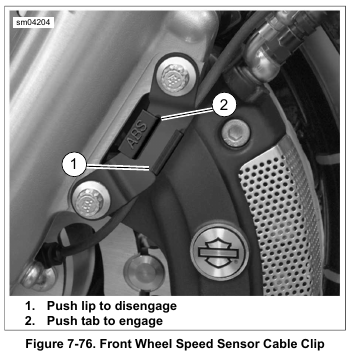
    4. See Figure 7-76. Release sensor cable from clip at caliper:
    a. Push on lip (1) at rear of clip to disengage from bracket. Rotate tab (2) (stamped ABS) rearward until clip is perpendicular to bracket and remove cable.
    b. Rotate tab (2) forward until clip is aligned with bracket and apply pressure to tab until lip (1) engages.

    5. Retract axle until front WSS is free. See 2.4 FRONT WHEEL.

    NOTE

    The WSS works in conjunction with the ABS encoder bearing installed in the wheel hub. If necessary, see 2.10 SEALED WHEEL BEARINGS for bearing removal and installation instructions.

    Installation

    NOTE

    Install WSS with index pin on the outboard side.

    1. Push axle through new front WSS and left fork slider.

    2. Secure front wheel. See 2.4 FRONT WHEEL. Rotate WSS until it makes contact with fork slider. Back off just enough to maintain clearance between the WSS wire stem and fork slider.

    3. Route sensor cable up to lower fork bracket following brake hose.

    4. Route connector up through opening in lower fork bracket.

    5. Frame mounted fairing models: Route cable between the upper and lower legs of inner fairing mounting bracket to the right steering head caddy.

    6. Continue to right steering head caddy. Mate connector and secure cable to caddy.

    7. Secure the sensor cable and fender tip lamp wires using three new cable straps:
    a. On the brake hose lower crimp capturing WSS cable and brake hose.
    b. Midway between the upper and lower brake hose crimps capturing WSS cable, brake hose and front fender tip lamp wires, if equipped.
    c. On upper crimp capturing WSS cable, brake hose and front fender tip lamp wires, if equipped.

    8. See Figure 7-76. Install WSS cable in retaining clip:
    a. Push on lip (1) at rear of retaining clip to disengage from bracket. Rotate tab (2) (stamped ABS) rearward until retaining clip is perpendicular to bracket. Install cable.
    b. Rotate tab (2) forward and apply pressure until lip (1) engages. Gently tug on cable to verify that retaining clip is properly installed.

    9. Fork mounted fairing models: Capture WSS cable to three retainers on brake hoses near steering head. Install outer fairing. See 2.37 OUTER FAIRING AND WINDSHIELD: FORK MOUNTED FAIRING MODELS.
     

  • 2015 Touring – VEHICLE SPEED SENSOR (VSS) – VSS

    Removal

    1. Remove starter. See 7.8 STARTER.

    2. See Figure 7-74. Disconnect VSS connector.

    3. Remove screw and pull sensor from transmission case.

    Installation

    1. Inspect VSS O-ring damage. Replace as necessary.

    2. Insert sensor into transmission case with screw. Tighten to 100-120 in-lbs (11.3-13.6 Nm).

    3. Connect VSS connector.

    4. Install starter. See 7.8 STARTER.


  • 2015 Touring – ALTERNATOR – INSTALLATION

    1. Feed connector and conduit through hole in crankcase from inside crankcase.

    2. Lubricate parts with glass cleaner or isopropyl alcohol.
    Ribs of grommet must be clean and free of dirt and oily residue.

    3. Push grommet into crankcase bore while carefully pulling on outside cable. Installation is complete when cable stop contacts casting and capped rib of grommet exits crankcase bore.

    NOTE

    Do not reuse stator mounting screws. The threads of the screws contain a locking compound in pellet form. When the screw is started, the pellet breaks, releasing the compound.

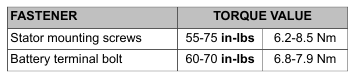
    4. Secure stator to crankcase using four new screws. Tighten to 55-75 in-lbs (6.2-8.5 Nm).

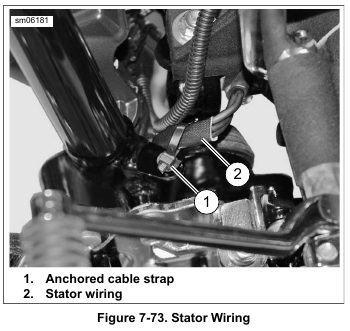
    5. See Figure 7-73. Install new anchored cable strap (1) on stator wiring (2). Push anchor into hole in frame.

    6. Install connector to voltage regulator and engage locking latch.

    The high-output rotor contains powerful magnets. Exercise caution to prevent possible hand injury during removal and installation. (00558b)

    7. Install rotor onto the compensating sprocket shaft.

    8. Install primary chaincase housing. See 5.5 PRIMARY CHAINCASE HOUSING.

    9. Connect negative battery cable. Tighten bolt to 60-70 in-lbs (6.8-7.9 Nm).

    10. Install seat. See 2.30 SEAT.