1. Place fuel tank onto frame backbone and start front fuel tank fasteners.
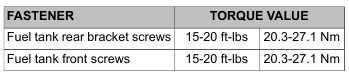
2. Secure rear fuel tank bracket to frame backbone with two screws. Tighten to 15-20 ft-lbs (20.3-27.1 Nm). If removed, install plastic trim cover over bracket.
3. Tighten front fuel tank screws to 15-20 ft-lbs (20.3-27.1 Nm). Install rubber caps over screws. Left and right caps
are not interchangeable.
To prevent spray of fuel, be sure quick-connect fittings are properly mated. Gasoline is extremely flammable and highly explosive, which could result in death or serious injury. (00268a)
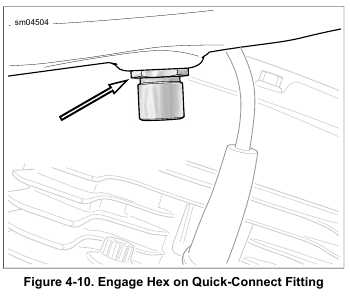
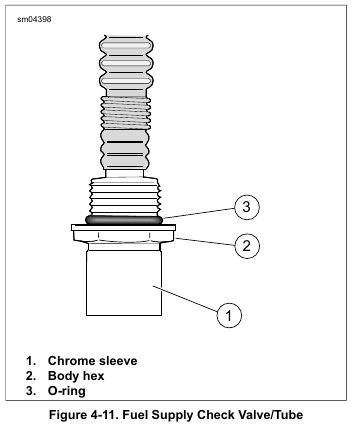
4. Connect quick-connect fitting to fuel tank. While pushing up on bottom of fitting, pull down on chrome sleeve. After completing installation, tug on fuel line fitting to verify that it is locked in position.
5. Road King Models: Mate fuel gauge connector. Feed connector into tunnel at front of fuel tank.
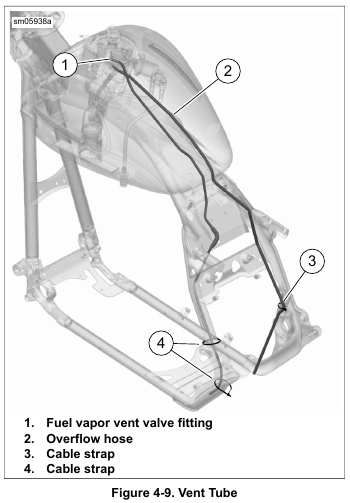
6. See Figure 4-9. Connect fuel vapor vent tube to vapor valve fitting (1) on top plate.
7. If equipped, connect overflow hose (2) to top plate and route along inner downtube as shown. Secure to brake line with cable strap (3). Do not over-tighten cable strap.
8. Install fuel level sender/fuel pump connector [141], 4-place Delphi. For best clearance with cam ring, tilt connector at 35 degree angle before installation.
9. Install console. See 4.6 FUEL TANK, Console.
10. Install seat. See 2.30 SEAT.
11. Install main fuse, left side cover and saddlebag.
NOTE
The low fuel lamp will not turn off until there is sufficient fuel in the tank, the ignition switch has been turned off and back on, and the vehicle has begun forward movement.