Author: Sam

  • 2015 Touring – CYLINDER – CLEANING

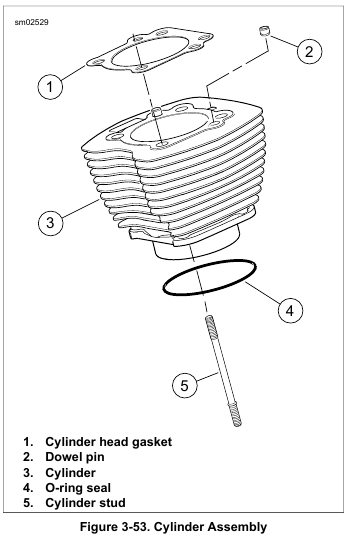
    1. See Figure 3-53. Scrape any remaining cylinder head gasket material from the gasket surface at the top of the cylinder (3).

    2. Clean cylinder in a non-volatile cleaning solution or solvent.
    Dry parts with low pressure compressed air. Verify that oil passageways are clean and open.

    3. Inspect the cylinder bore for obvious defects or damage in the ring travel area. Replace cylinders that are severely scored, scuffed, scratched, burnt or gouged.

    4. Use a file to carefully remove any nicks or burrs from the machined surfaces of the cylinder.


  • 2015 Touring – CYLINDER HEAD – ASSEMBLY

    1. Secure cylinder head for service.
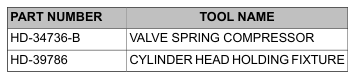
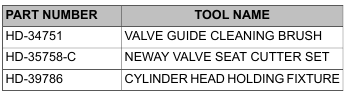
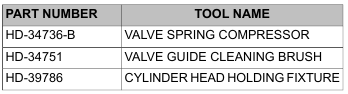
    a. Thread 12 mm end of CYLINDER HEAD HOLDING FIXTURE (Part No. HD-39786) into cylinder head spark plug hole.
    b. Clamp tool in vise at a 45 degree angle or one that offers a comfortable working position.

    NOTE

    At the time of disassembly, all parts should have been marked or tagged so that they are installed on the same valve (and in the same head).

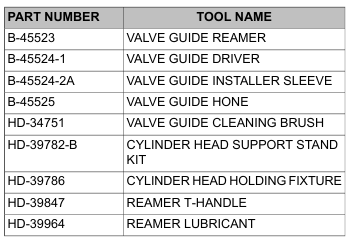
    2. Run the VALVE GUIDE CLEANING BRUSH (Part No. HD-34751) through the valve guide bore to verify cleanliness.

    3. Apply a liberal amount of SCREAMIN’ EAGLE ASSEMBLY LUBE to valve stem.

    4. Install the valve into the cylinder head.

    5. To distribute the assembly lube evenly around the valve stem and guide, hand spin the valve as it is installed. Work the valve back and forth in the bore to verify that it slides smoothly and seats properly.

    6. Remove the valve and apply a second coat of SCREAMIN’ EAGLE ASSEMBLY LUBE to the valve stem. Install the valve.

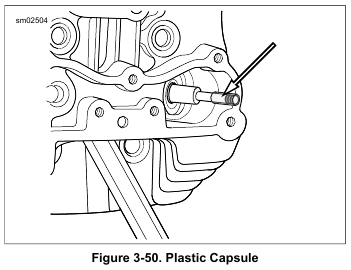
    Failure to install plastic capsule can cause the valve stem seal to catch the edge of the valve stem keeper groove. The resulting damage can cause leakage around the valve stem, excessive oil consumption and valve sticking. (00535b)

    7. See Figure 3-50. Hold valve against the valve seat. Slide plastic capsule over valve stem tip and keeper groove.

    8. Apply a very thin film of SCREAMIN’ EAGLE ASSEMBLY LUBE to capsule.

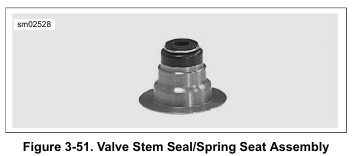
    9. See Figure 3-51. Slide new valve stem seal/spring seat over capsule and down valve stem until seated against cylinder head casting. Remove capsule from valve stem tip.

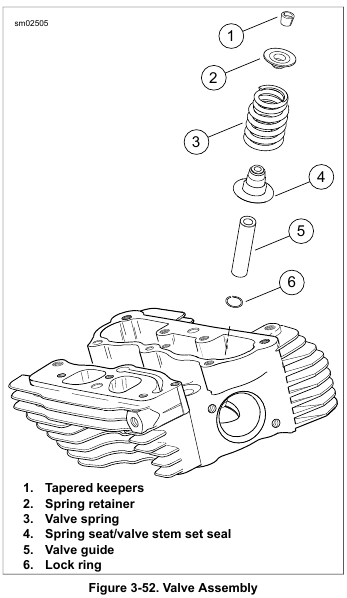
    10. See Figure 3-52. Apply a liberal amount of SCREAMIN’ EAGLE ASSEMBLY LUBE to valve stem tip and keeper groove (1).

    11. With the smaller diameter coils topside, install the valve spring (3). Place the spring retainer (2) on top of the valve spring.

    12. Install keepers:
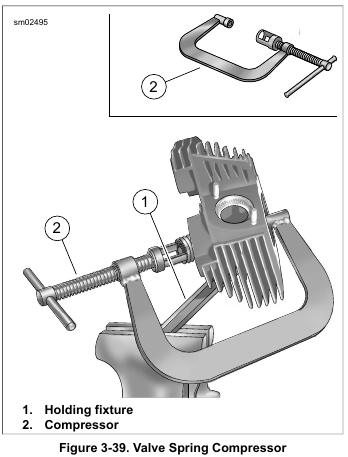
    a. Place VALVE SPRING COMPRESSOR (Part No. HD-34736-B) over cylinder head so that the blunt end is centered on the valve head and adapter at end of
    forcing screw is seated on the valve spring retainer.
    b. Rotate forcing screw to compress valve spring.
    c. With the tapered side down, fit the keepers into the valve stem groove. For best results, apply a dab of grease to the inboard side of the keepers before
    installation and use a magnetic rod for easy placement.
    d. Arrange tapered keepers so that the gaps are evenly spaced and release valve spring compression.

    13. Tap the end of the valve stem once or twice with a soft mallet to be sure that tapered keepers are tightly seated.

    14. Install the other valve and components.

    15. Twin-Cooled models: Install fittings and lines to cylinder head. See C.5 COOLING SYSTEM REPAIR, Upper Coolant Line Installation.

    16. Release the cylinder head holding fixture from the vise.
    Remove fixture tool from spark plug hole.

    17. Cover the cylinder head to protect it from dust and dirt until time of installation.


  • 2015 Touring – CYLINDER HEAD – VALVE AND SEAT REFACING

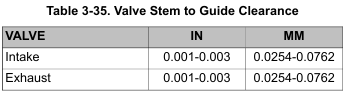
    • Verify correct valve stem to valve guide clearance before refacing. If new guides must be installed, complete that task before refacing valve seats. Refer to Table 3-35.

    • This procedure is not based on the lapping of valves. The end result is an interference fit between the 45 degree valve face and the valve seat which will be 46 degrees.

    1. Remove carbon deposits from valve head, face and stem with a wire wheel. Do not remove any metal. Carbon left on stem may affect alignment during valve refacing.

    2. Polish valve stem with steel wool or crocus cloth to remove marks left by wire wheel.

    3. Grind valve face to a 45 degree angle using a valve grinding machine.

    NOTES

    • Do not remove any more metal than necessary to clean up and true the valve face.

    • Replace the valve if margin is less than 0.0313 in (0.795 mm). See Figure 3-47.
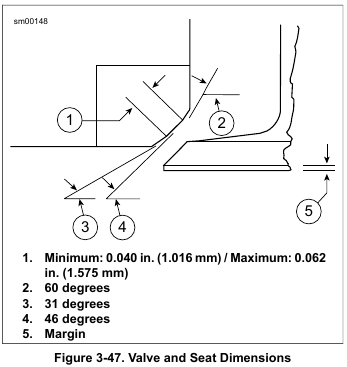
    4. Wipe valve seats and valve faces clean. Install the valve into the valve guide. Push on head of valve until it contacts the valve seat.

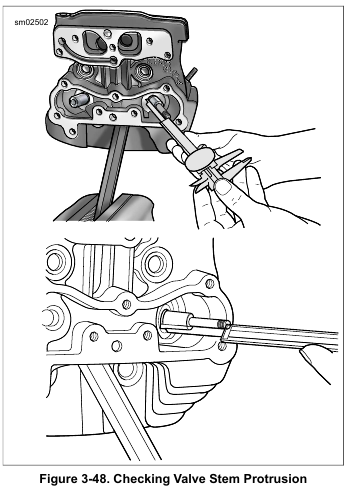
    5. See Figure 3-48. Measure valve stem protrusion.
    a. Use a dial caliper to check the distance from the top of the valve stem to the machined area on the cylinder head.
    b. If protrusion exceeds 2.069 in. (52.553 mm), replace the valve, valve seat or cylinder head as necessary.

    NOTE

    Do not shorten the valve by grinding the end of the stem.
    Grinding removes the hardened case which results in accelerated wear.

    6. Secure cylinder head for servicing.
    a. Thread 12 mm end of CYLINDER HEAD HOLDING FIXTURE (Part No. HD-39786) into cylinder head spark plug hole.
    b. Clamp fixture in vise and further tighten cylinder head onto the fixture to prevent any movement during operation.
    c. Place cylinder head at a 45 degree angle or one that offers a comfortable working position.

    7. To determine the correct location of the 46 degree valve seat in the head, measure the diameter of the valve head and subtract 0.080 in. (2.032 mm) from that number.

    8. Set the dial caliper to the lesser measurement and lock down for quick reference. This is the diameter of the valve seat.

    9. Use a permanent marker to highlight the valve seat area.
    Highlight all three angles. Allow marker to dry before proceeding.
    • Always verify cutter blades and cutter pilot are clean before beginning the cutting process. The correct cleaning brush is supplied with the Neway tool set.

    • Always verify the inside of the valve guide is clean by using VALVE GUIDE CLEANING BRUSH (Part No. HD-34751).

    NOTES

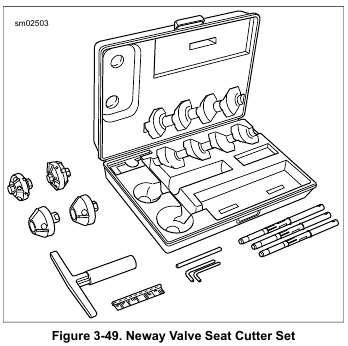
    10. See Figure 3-49. Obtain the NEWAY VALVE SEAT CUTTER SET (Part No. HD-35758-C). Choose the cutter pilot that fits properly into the valve guide hole. Securely seat the pilot by pushing down and turning using the installation tool supplied in the tool set.

    11. Choose the proper 46 degree cutter (intake or exhaust) and gently slide the cutter onto the pilot. Do not drop the cutter onto the seat.

    12. While applying a constant and consistent pressure, remove only enough metal to provide a uniform finish and to remove pitting.

    NOTES

    • If the width of the clean-up cut is greater on one side of the seat than the other, the guide may need to be replaced due to improper installation.

    • If a groove cut completely around the seat is apparent, slightly stagger the blades of the cutter.

    13. Measure the 46 degree cut at the outermost edge at the widest point of the circle to determine what cut will be made next.
    a. If the outer diameter is too large, use the 31 degree cutter to lower the valve seat.
    b. If the outer diameter is too small, use the 46 degree cutter to widen the valve seat or move it away from the port.

    NOTES

    • Because the OD measurement of the valve seat is used as a reference point it will usually be necessary to use the 31 degree cutter following the initial 46 degree cut.
    •  Always highlight the valve seat with the permanent marker in order to better view the location of the 46 degree valve seat.
    14. If the location of the valve seat is not correct, repeat steps 10 through 13.

    15. When a complete clean-up of the 46 degree angle is accomplished and the width is at least 0.062 in. (1.575 mm), proceed to the next step.

    16. Select the proper 60 degree cutter and gently slide the cutter down the cutter pilot to the valve seat.

    17. Remove just enough material to provide an even valve seat width of 0.040-0.062 in. (1.016-1.575 mm).

    18. Remove cutter and cutter pilot.

    19. Insert valve into the cylinder head. Use thumb pressure against valve to hold it closed.

    20. Completely fill the port with solvent to verify proper seal between valve and valve seat.

    NOTE

    Hold pressure against the valve for a minimum of 10 seconds. If any leakage occurs, examine the valve and valve seat for irregularities or defects. If necessary repeat the above valve grinding or valve seat cutting process.

    21. Repeat the process on any valve seat that needs service.

    22. Clean valves, cylinder head and valve seats in solvent. Follow up with a thorough wash in hot soapy water.

    23. Dry parts with low pressure compressed air.


  • 2015 Touring – CYLINDER HEAD – VALVE GUIDE REPLACEMENT

    Removal

    NOTES

    • If valve guide replacement is necessary, always install new guide before refacing valve seat.
    • CYLINDER HEAD SUPPORT STAND KIT (Part No. HD-39782-B) ensures that valve guide and seat are perpendicular. Not keeping cylinder head valve guide bore perpendicular will result in damage during the press procedure.

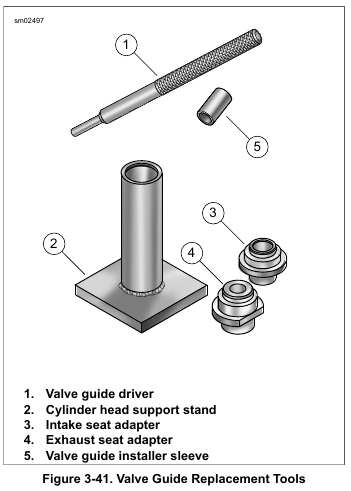
    1. See Figure 3-41. Prepare cylinder head for valve guide replacement.
    a. Obtain CYLINDER HEAD SUPPORT STAND KIT (Part No. HD-39782-B).
    b. Insert sleeve of appropriate seat adapter (3 or 4) into tube at top of support stand (2).
    c. Position cylinder head so that valve seat is centered on seat adapter.

    NOTE

    Always press valve guide toward combustion chamber. Carbon buildup on combustion chamber side of guide can damage cylinder head bore. this may prevent a proper interference fit.

    2. Remove and discard lock ring from valve guide groove.

    NOTE

    Lock ring is present on OEM intake and exhaust valve guides.

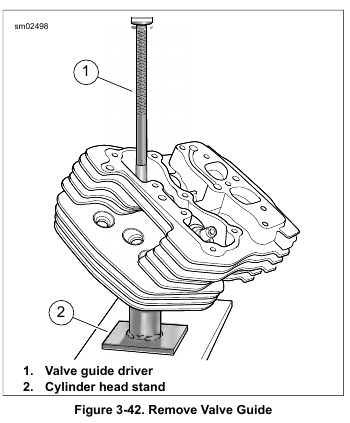
    3. Insert VALVE GUIDE DRIVER (Part No. B-45524-1) (1)
    into valve guide bore.

    4. See Figure 3-42. Center valve guide driver under ram of arbor press. Apply pressure until valve guide drops free of cylinder head. Discard valve guide.

    Installation

    1. Check valve guide to valve bore interference fit.
    a. Measure the outside diameter of a new standard valve guide.
    b. Measure the cylinder head valve guide bore. The valve guide should be 0.0020-0.0033 in. (0.051-0.084 mm) larger than the bore.
    c. If interference is not within specification, select one of the following oversize guides: 0.001 in. (0.025 mm), 0.002 in. (0.05 mm) or 0.003 in. (0.08 mm).

    NOTE

    Pressing out guide may remove material. Using the next larger size is not uncommon to guarantee proper interference fit.

    2. Select an oversize guide that will provide the correct interference fit.

    NOTE

    The support stand ensures that valve guide and seat are perpendicular. This alignment helps prevent damage during the press procedure.

    3. Prepare cylinder head for valve guide replacement.
    a. See Figure 3-41. Insert sleeve of the appropriate seat adapter (3 or 4) into tube at top of support stand (2).
    Position cylinder head so that valve seat is centered on seat adapter.
    b. Apply a thin film of petroleum jelly to lightly lubricate external surface of valve guide.
    c. Start valve guide into bore.
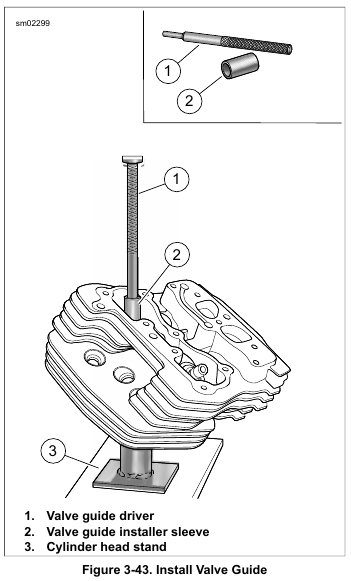
    d. See Figure 3-43. Place VALVE GUIDE INSTALLER SLEEVE (Part No. B-45524-2A) (2) over valve guide and then insert valve guide driver (1) into sleeve.
    e. Center valve guide driver under ram of arbor press and apply pressure only until valve guide is started in bore and then back off ram slightly to allow guide to center itself.

    NOTE

    Always back off ram to allow the valve guide to find center. Pressing guide into cylinder head in one stroke can bend driver, break guide, distort cylinder head casting and/or damage cylinder head valve guide bore.

    f. Verify that support stand (3) and driver (1) are square. Center driver under ram and press valve guide further into bore, then back off ram again to allow valve guide to center itself.
    g. Repeat previous step until installer sleeve contacts machined area of cylinder head.
    h. Install new lock ring into valve guide groove. Verify that lock ring is square and fully seated in the groove.

    4. Secure cylinder head for service.
    a. Thread 12 mm end of CYLINDER HEAD HOLDING FIXTURE (Part No. HD-39786) into cylinder head spark plug hole.
    b. Clamp tool in vise at a 45 degree angle or one that offers a comfortable working position.

    NOTE

    Valve guides are reamed to within 0.0005-0.0001 in. (0.013-0.0025 mm) under finished size.

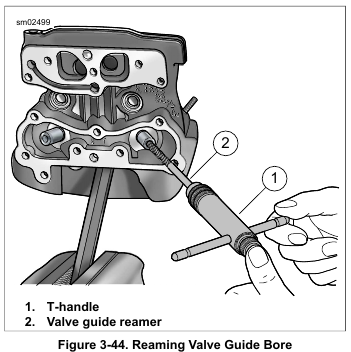
    5. See Figure 3-44. Ream the guide.
    a. Install REAMER T-HANDLE (Part No. HD-39847) (1) on VALVE GUIDE REAMER (Part No. B-45523) (2).
    b. Apply a liberal amount of REAMER LUBRICANT (Part No. HD-39964) to valve guide bore and reamer. Start reamer into bore.

    NOTE

    Never turn reamer counterclockwise.

    c. Apply slight pressure on reamer while rotating clock wise. Squirt additional lubricant onto reamer and into guide as necessary.

    NOTE

    For best results, do not push reamer or apply pressure to the reamer handle. Excessive pressure results in a rough cut and the bore will be tapered if pressure is not centrally applied.

    d. Continue rotating reamer T-handle until entire bit has passed through valve guide bore.
    e. Remove T-handle from reamer, and carefully draw out reamer through combustion chamber side of valve guide.

    6. Remove metal shavings with low pressure compressed air.

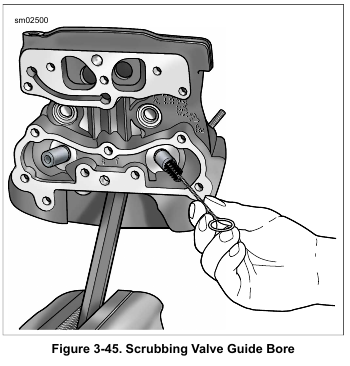
    7. See Figure 3-45. Clean valve guide bore with the VALVE GUIDE CLEANING BRUSH (Part No. HD-34751).

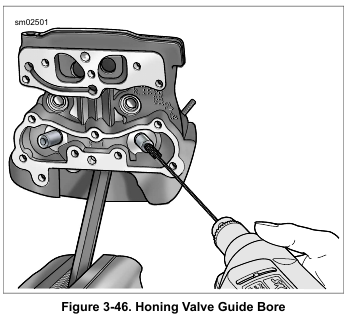
    8. See Figure 3-46. Hone bore to finished size.
    a. Install VALVE GUIDE HONE (Part No. B-45525) in a high-speed electric drill.
    b. Apply reamer lubricant to stones of hone and valve guide bore.
    c. Start stones of hone into bore.
    d. Rotate the hone while moving the stones through the entire length of the bore for 10-12 complete strokes. Work for a crosshatch pattern of approximately 60 degrees.

    9. Remove debris with low pressure compressed air. Clean with the VALVE GUIDE CLEANING BRUSH (Part No. HD-34751).

    NOTE

    Always check valve stem to valve guide clearance after honing.

    10. Check valve stem to valve guide clearance. Refer to Table 3-35. If the clearance is not within specification, repeat the honing process and recheck.

    11. Clean cylinder head assembly.
    a. Using cleaning solvent, thoroughly clean cylinder head and valve guide bore.
    b. Scrub valve guide bore with the VALVE GUIDE CLEANING BRUSH (Part No. HD-34751). For best results, clean the valve guide bore with the type of swabs or patches found in gun cleaning kits and a thin engine oil.
    c. Continue to wipe bore until a clean cloth shows no evidence of dirt or debris. Follow up with a thorough wash in hot soapy water.

    12. Dry parts with low-pressure compressed air.


  • 2015 Touring – CYLINDER HEAD – INSPECTION

    Cylinder Head

    1. Check for scratches and nicks on all gasket sealing surfaces.

    2. Check for warpage.
    a. Place a straightedge diagonally across the cylinder head gasket surface.
    b. Slide a feeler gauge beneath the straightedge to check the head for warpage.
    c. Repeat the procedure on the opposite diagonal. Discard the head if warpage is 0.006 in. (0.152 mm) or greater.

    3. Check for warpage (alternate method.)
    a. Use one of the CYLINDER TORQUE PLATES (Part No. HD-42324-A) in lieu of the straightedge.
    b. Lay the upper plate (without vise grip) flat on the machined surface of the head.
    c. As a preliminary check, see if the plate rocks from side to side. A head on which the plate rocks is immediately suspect.
    d. Insert a feeler gauge between the plate and head at various locations.
    e. Discard the head if warpage is 0.006 in. (0.152 mm) or greater.

    4. Verify that oil passageways are open and clean.

    Valve Guides

    1. Inspect external surfaces, particularly the combustion chamber side, for cracks. Replace as necessary.

    2. Prepare valve guides for inspection.
    a. Lightly hone bore using the VALVE GUIDE HONE (Part No. B-45525).
    b. Scrub with the VALVE GUIDE CLEANING BRUSH (Part No. HD-34751) to remove any dust or debris.
    c. Polish the valve stem with fine emery cloth or steel wool to remove carbon buildup.

    3. Check valve stem to guide clearance:
    a. Carefully measure the inside diameter of the valve guide using a ball gauge.
    b. Measure the outside diameter of the valve stem with a micrometer.
    c. Refer to Table 3-34. If the clearance between stem and guide exceeds the limits shown, the valve stem and/or guide are excessively worn.
    d. Repeat measurements with a new valve to determine if the guide must be replaced.

    Valves

    1. Replace the valve if there is evidence of burning or cracking.

    2. Inspect the end of the valve stem for pitting or uneven wear. Replace as necessary.

    3. Inspect for burrs around the valve stem keeper groove.
    Remove burrs with a fine tooth file.

    4. To determine if the valve stem is excessively worn, see valve guide inspection.

    Valve Springs

    1. Inspect springs for cracked or discolored coils. Replace as necessary.

    2. Set the valve springs on a level surface. Check for proper squareness.

    3. Check free length of springs using a caliper and load test using a commercially available valve spring tester. Replace springs if free length or compression force do not meet specifications. See 3.2 SPECIFICATIONS.

    Tapered Keepers

    Install new keepers any time valves are installed.

    Valve Seats

    1. Inspect seats for cracking, chipping or burning. Replace as necessary.

    2. Check seats wear by measuring valve stem protrusion.
    See 3.22 CYLINDER HEAD, Valve and Seat Refacing.


  • 2015 Touring – CYLINDER HEAD – CLEANING

    1. See Figure 3-40. Remove old gasket material from cylinder head (9). Gasket material left on sealing surfaces will cause leaks. Scraping may result in scratches or nicks.

    NOTE

    Bead blasting materials could also enter threaded holes. This would adversely affect fastener engagement and torque indication. Cover all threaded holes before bead blasting.

    2. Remove all carbon deposits from combustion chamber and machined surfaces of cylinder head. Do not remove any metal material.

    3. To soften stubborn deposits, soak the cylinder head in a chemical solution, such as GUNK HYDRO-SEAL or other carbon and gum dissolving agent. Repeat previous step as necessary.

    4. Thoroughly clean the cylinder head, spring retainers, tapered keepers, valves and valve springs in a non-volatile cleaning solution or solvent. Follow up with a thorough wash in hot soapy water.

    5. Dry parts with low pressure compressed air.
  • 2015 Touring – CYLINDER HEAD – DISASSEMBLY

    1. Twin-Cooled models: Remove lines and fittings from cylinder head. See C.5 COOLING SYSTEM REPAIR, Upper Coolant Line Removal.

    2. Before proceeding with the disassembly procedure, determine if valve reconditioning is necessary. Use either of the following procedures:
    a. Raise valve ports of cylinder head to strong light source. If light is visible between valves and seats, the cylinder head and valves require reconditioning.
    b. Fill ports with solvent. Wait ten full seconds and check for leakage past valve seats. Recondition cylinder heads and valves that leak.

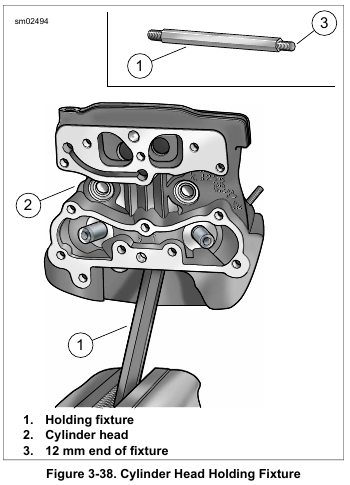
    3. See Figure 3-38. Secure cylinder head for service.
    a. Thread 12 mm end of CYLINDER HEAD HOLDING FIXTURE (Part No. HD-39786) (1) into cylinder head (2) spark plug hole.
    b. Clamp tool in vise at a 45 degree angle or one that offers a comfortable working position.

    4. See Figure 3-39. Release valve spring compression.
    a. Place VALVE SPRING COMPRESSOR (Part No. HD-34736-B) (2) over cylinder head. Center blunt end on the valve head. Seat adapter at end of forcing screw on the valve spring retainer.
    b. See Figure 3-40. Rotate forcing screw to compress valve spring until keepers (1) can be removed from the valve stem (11).
    c. Rotate forcing screw to release the valve spring compression.

    5. Remove the spring retainer (2) and valve spring (3).

    6. Slide the valve (11) from the valve guide (5).

    7. Remove valve seal assembly.

    8. Mark the valve head F(ront) or R(ear) for identification. Also, separate and tag tapered keepers, valve spring and spring retainer so that they are installed on the same valve at time of assembly.

    9. Remove the remaining valve and components.

    10. Remove fixture tool from spark plug hole.

  • 2015 Touring – PUSHRODS, LIFTERS AND COVERS – ASSEMBLY

    With the exception of the pushrod covers, all parts will be assembled during the installation procedure.

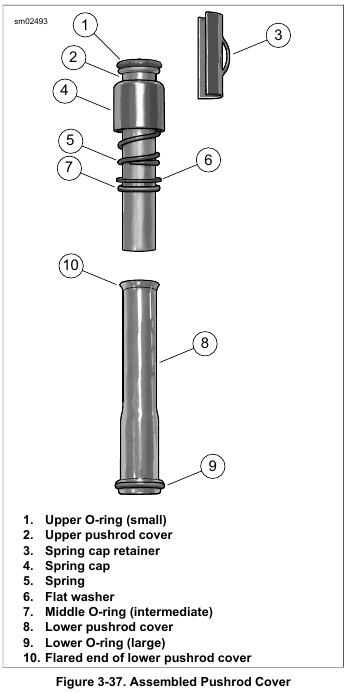
    1. See Figure 3-37. Apply a very thin film of clean engine oil to new O-rings (1, 7 and 9) before installation.

    2. Install small O-ring (1) on seat at the top of the upper pushrod cover (2).

    3. Slide the spring cap (4), spring (5), flat washer (6) and intermediate size O-ring (7) onto the body of the upper pushrod cover. Move parts up body until spring cap contacts upper O-ring seat.

    4. Fit the straight end of the upper pushrod cover into the flared end of the lower pushrod cover (8).

    5. Install large O-ring (9) on seat at bottom of lower pushrod cover.


  • 2015 Touring – PUSHRODS, LIFTERS AND COVERS – LIFTER INSPECTION

    1. Inspect lifters for excessive clearance in bores. Accurately measure the lifter outer diameter and record the measurement.

    2. Accurately measure lifter bore inner diameter with a snap gauge. Subtract this measurement from the lifter measurement to determine clearance.
    a. Clearance should be within 0.0008-0.0020 in (0.0203-0.0508 mm).
    b. Install new lifters and/or replace crankcases if clearance exceeds service wear limit of 0.007 in (0.076 mm).

    3. Check lifter roller end clearance.
    a. End clearance should be within 0.008-0.022 in (0.203-0.559 mm).
    b. Replace lifters if end clearance exceeds service wear limit of 0.022 in (0.559 mm).

    4. Soak lifters in clean engine oil. Keep covered until assembly.


  • 2015 Touring – PUSHRODS, LIFTERS AND COVERS – CLEANING AND GENERAL INSPECTION

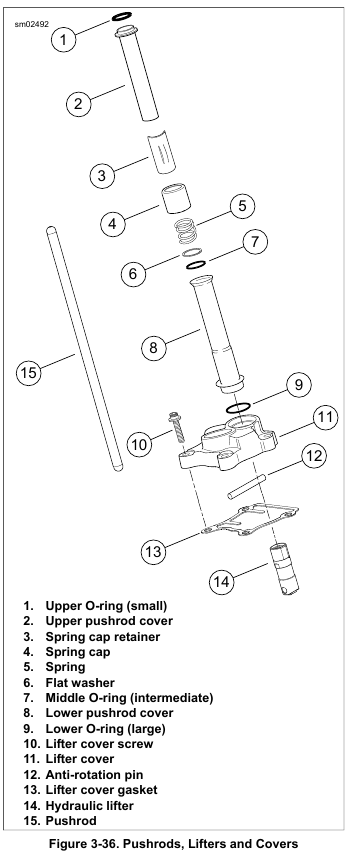
    1. See Figure 3-36. Clean old gasket material from the lifter cover (11).

    2. With the exception of the hydraulic lifters (14), clean all parts in a non-volatile cleaning solution or solvent. Verify that the O-ring seats and contact surfaces of the pushrod covers (2, 8) are completely clean.

    3. Dry parts with low pressure compressed air. Verify that all oil holes are clean and open.
    4. Verify that the hydraulic lifter rollers turn freely and are free of flat spots, scuff marks and pitting. If flat spots exist, examine the cam lobe on which the lifter operates.

    5. Inspect the lifter socket for signs of wear. Verify that the plunger of the hydraulic lifter is fully extended up against the C-clip. Use index finger to pump plunger to verify lifter
    operation.

    6. Examine the pushrods (15). Replace any pushrods that are bent, dented, damaged, discolored or if the ball ends show signs of excessive wear or damage.

    7. Cover all parts with a clean plastic sheet to protect them from dust and dirt.