Author: Sam

  • 2015 Touring – TOP END OVERHAUL: ASSEMBLY – CYLINDER

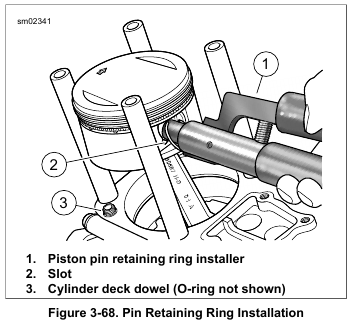
    1. See Figure 3-68. Apply a very thin film of clean engine oil to new O-rings for both lower cylinder deck dowels. Install and verify that O-ring is properly seated in groove.

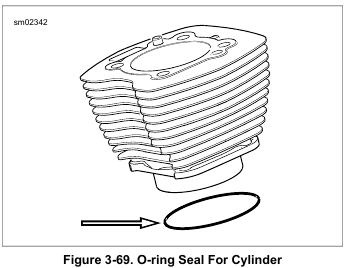
    2. See Figure 3-69. Apply a very thin film of clean engine oil to new O-ring seal for the bottom of the cylinder liner.
    Install new O-ring seal.

    NOTE

    Excessive lubrication of cylinder sleeve O-ring seal will result in oil weepage between cylinder and crankcase as engine is run. This condition may be incorrectly diagnosed as an oil leak.

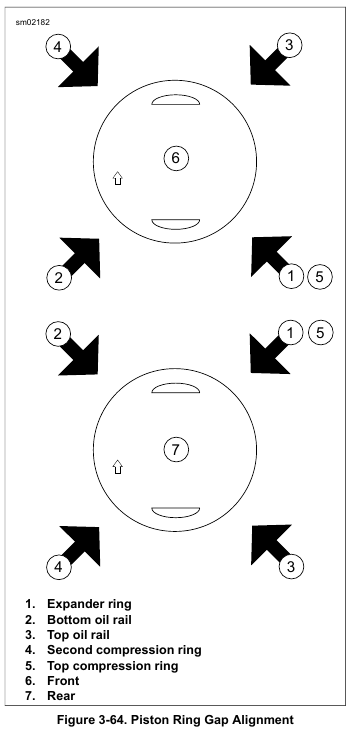
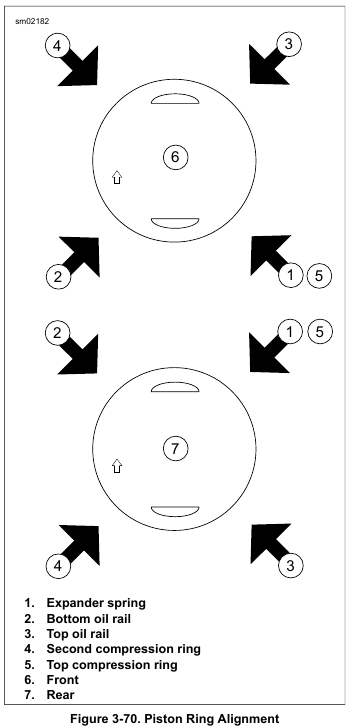
    3. See Figure 3-70. Verify that the piston ring end gaps are staggered. Rotate each ring to position the gap 90 to 180 degrees from the gap in the ring above it. Locate the top piston ring (5) gap towards the intake port.

    4. Apply clean engine oil to piston, piston rings and cylinder bore.

    5. Remove protective covers from cylinder studs. Rotate engine until piston is at top dead center. If necessary, see 3.18 TOP END OVERHAUL: DISASSEMBLY, Rocker Arm Support Plate for different methods of engine rotation.

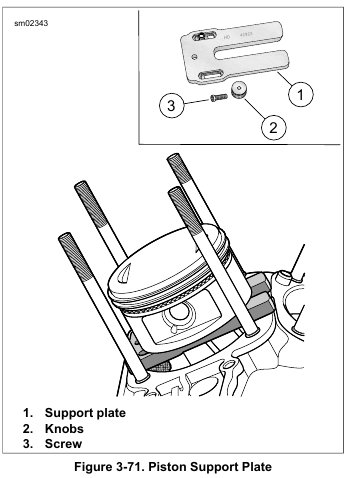
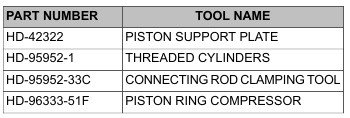
    6. See Figure 3-71. Install the PISTON SUPPORT PLATE (Part No. HD-42322).
    a. Slide both adjustable knobs (2) on support plate (1) down away from forked end. Tighten knobs when contact is made with flats at end of slots.
    b. With the forked end of the tool pointing towards the center of the engine and the adjustable knobs facing downward, capture shank of connecting rod in fork. Lay tool on cylinder deck so that adjustable knobs contact wall of cylinder bore.
    c. Rotate engine until piston skirt is centered and firmly seated on top of support plate.

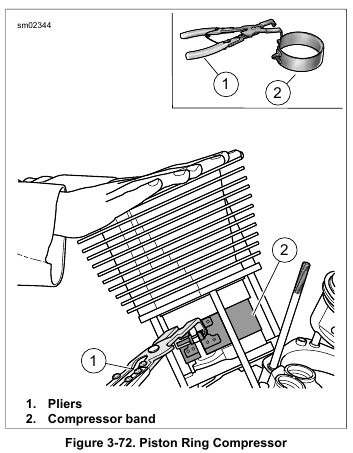
    7. See Figure 3-72. Install cylinder using PISTON RING COMPRESSOR (Part No. HD-96333-51F).
    a. Fit tabs on pliers (1) into slots of ring compressor band (2). The arrow stamped on the band indicates the side that faces up. The word “bottom” refers to the piston bottom.
    b. Place band around piston. Press the lever on the right side of the pliers to open the jaws for band expansion.
    c. Orient tool so that the top of the band is positioned between the top compression ring and the piston crown.
    d. Tightly squeeze handles of tool to compress piston rings. The ratcheting action of the tool allows release of the handles after the rings are compressed.
    e. With the indent in the cooling fins facing the right side of the engine, gently slide cylinder over the cylinder studs and the piston crown resting it on the top of the ring compressor band.
    f. Place the palms of both hands at the top of the cylinder. Push down on the cylinder with a sharp, quick motion to pass the piston ring area.
    g. Rotate the engine slightly to raise piston off support plate. Remove pliers from band and then remove band from around shank of connecting rod. Remove piston support plate.

    8. Remove shop towels from around the crankcase bore and keep out any dirt or debris.

    9. Carefully set the cylinder over the two dowel pins in the cylinder deck. Push down on the cylinder until it is fully seated in the crankcase bore.

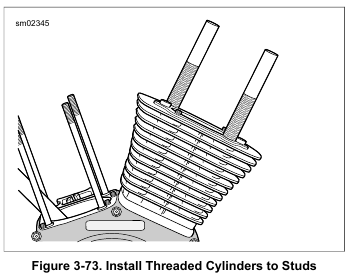
    10. See Figure 3-73. Install THREADED CYLINDERS (Part No. HD-95952-1) from CONNECTING ROD CLAMPING TOOL (Part No. HD-95952-33C) onto cylinder studs with the knurled side down.
     

  • 2015 Touring – TOP END OVERHAUL: ASSEMBLY – PISTON

    1. Slide approximately 6.0 in. (152 mm) of plastic tubing, rubber hose or conduit over each cylinder stud, if removed. Use material with I.D. of 0.5 in. (12.7 mm) to protect cylinder studs and piston from damage.

    2. Apply SCREAMIN’ EAGLE ASSEMBLY LUBE to piston pin, piston bosses and upper connecting rod bore.

    3. Remove water pipe insulation from connecting rod shank.

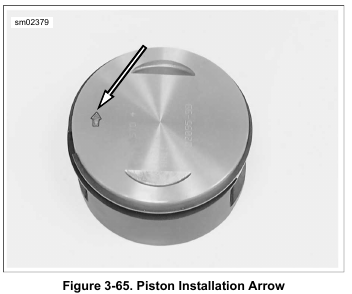
    4. See Figure 3-65. Place piston over rod end so that the arrow stamped at the top of the piston points toward the front of the engine.

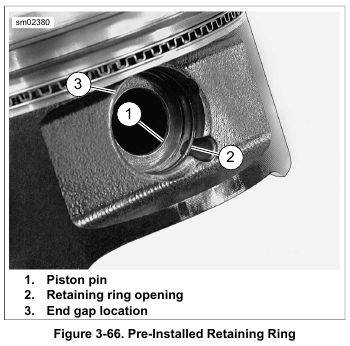
    5. See Figure 3-66. Insert piston pin (1) through pin bore and upper connecting rod bore. Push pin until it contacts retaining ring installed in opposite pin boss. Verify that end gap (3) for retaining ring is 180 degrees from opening (2).

    6. Place clean shop towels over the cylinder and lifter bores to prevent the piston pin retaining ring from falling into the crankcase. Verify that the retaining ring groove is clean and free of dirt and grime.

    NOTE

    Do not reuse piston pin retaining rings. They could weaken during removal causing them to break or dislodge during engine operation. This condition will result in engine damage.

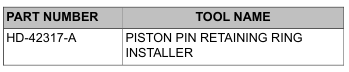
    7. Install new piston pin retaining ring with the PISTON PIN RETAINING RING INSTALLER (Part No. HD-42317-A).
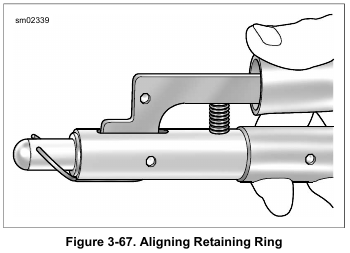
    a. See Figure 3-67. Slide retaining ring down nose of tool until it contacts claw. Lightly squeeze handles of tool to capture retaining ring in claw.
    b. Releasing pressure on handles, rotate retaining ring so that the end gap is centered at top of tool and then recapture in claw.
    c. Tilt the retaining ring forward until the end gap contacts nose of tool.
    d. See Figure 3-68. Insert the tool (1) into the piston pin bore until claw is aligned with slot (2) in piston.
    e. Firmly push the tool into the piston pin bore until it bottoms. Release handles and remove tool.
    f. Inspect the retaining ring to verify that it is fully seated in the groove.


  • 2015 Touring – TOP END OVERHAUL: ASSEMBLY – GENERAL

    NOTES

    • It is assumed that each step performed on one cylinder is automatically repeated on the other.

    • Do not use 2006 and earlier connecting rods with 2007 and later pistons. 2007 and later pistons have a tapered wrist pin boss. The wrist pin portion of the 2007 and later connecting rod is tapered to match the boss on the piston.

    This section provides a sequential process for top end assembly after a complete disassembly. If only a partial disassembly was performed, start where necessary and continue to the end of the section.


  • 2015 Touring – PISTON – ASSEMBLY

    Checking Piston Ring Gap

    NOTES

    • Always use new piston rings. Piston rings take a definite set and must not be reused if the engine has been operated. Always deglaze (or hone) the cylinder before installing new rings.
    • Insufficient ring gap may cause the ends to abut at operating temperatures. This will result in ring breakage, cylinder scuffing and/or piston seizure.
    • Excessive ring gap results in high oil consumption and blow-by of exhaust gases. Blow-by contaminates the oil supply and leaves sludge in the crankcase. It also reduces engine efficiency by weakening the combustion seal necessary for efficient transfer of energy to the piston.

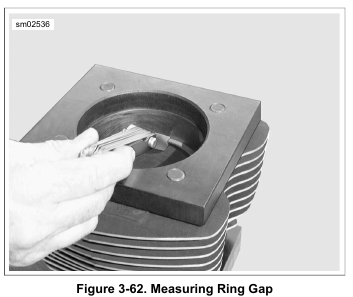
    1. See Figure 3-62. Check ring end gap of each ring before placing on the piston. Insert the new ring into the cylinder and square it in the bore using the top of the piston.

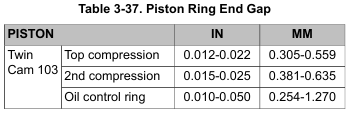
    Measure the ring end gap with a feeler gauge. Refer to Table 3-37.

    NOTE

    Ring end gap dimensions also apply to oversize rings. Replace ring if end gap exceeds specification. If end gap is under specification, filing is permissible.

    2. Use compressed air to remove any dirt or dust that may have settled in the oil drain holes and piston ring grooves.

    Installing Piston Rings
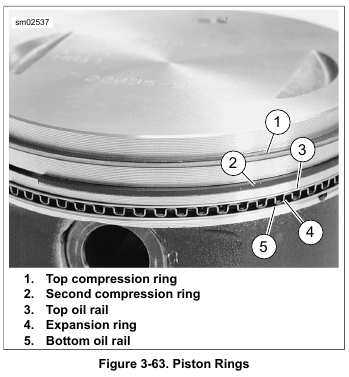
    1. See Figure 3-63. Apply clean engine oil to three piston ring grooves.
    2. Install expansion ring (4) into third ring groove.
    3. Spiral bottom oil rail (5) into space below expansion ring (4). Position gap 90 degrees from the gap in the expansion ring.
    4. Spiral top oil rail (3) into space above expansion ring (4).
    Position gap 180 degrees from the gap in the bottom oil rail.

    NOTES

    • Use the proper piston ring spreader to prevent excessive ring twist and expansion. Over expansion may cause the ring to crack. Damaged or distorted rings result in blow by of exhaust gases. This will result in increased oil con-
    sumption and lower service life on valves and other components.
    • Installing the second compression ring upside down will cause oil to be scraped up into the combustion chamber. This will result in excessive oil consumption and lower service life on valves and other components.

    5. Using PISTON RING EXPANDER (Part No. Snap-on PRS8), carefully install the second compression ring. Make sure the dot (punch mark) near the ring gap faces the piston crown. Rotate the ring so the gap is 180 degrees from the gap in the oil expansion ring.

    6. Install the top compression ring. Make sure the dot (punch mark) near the ring gap faces the piston crown. Rotate the ring so the gap is 180 degrees from the gap in the second compression ring.

    7. Rotate the three piston rings using the palms of both hands. The rings must rotate freely without sticking.

    8. See Figure 3-64. Verify the ring gaps are still properly staggered.


  • 2015 Touring – PISTON – INSPECTION

    1. See Figure 3-59. Check piston pin. Pin must slide without
    binding.
    a. Insert a lightly oiled good piston pin into the piston pin bore to feel for the proper interference fit. The pin should slide in and out without binding, but also without pivoting or rocking.
    b. Measure pin and pin bore diameters to determine running clearance. Replace piston and/or pin if clearance exceeds 0.0008 in (0.02 mm).

    NOTE

    Pistons with superficial wear marks, minor scratching or mild scoring are acceptable for use.

    2. Carefully inspect the pistons for damage or excessive wear. Discard if any of the following conditions are found:
    a. Cracked, worn or bent ring lands.
    b. Cracks, gouges, deep scratches or heavy scoring.
    c. Evidence of burning, etching or melting.
    d. Marks or imprints caused by contact with valves.

    3. Run your index finger around the edge of the piston crown to feel for dings, nicks or burrs. Lightly file the edge of the crown to remove any defects.

    NOTE

    Worn ring grooves result in high oil consumption and blow-by of exhaust gases. Blow-by of exhaust gases contaminate the engine oil supply with acids and leaves sludge in the crankcase.
    It also reduces engine efficiency by weakening the combustion seal necessary for efficient transfer of energy to the piston.

    4. See Figure 3-60. Measure piston ring side clearance.
    a. Insert the edge of a new ring into the piston ring groove. Insert a feeler gauge between the upper surface of the ring and the ring land.
    b. Since the grooves wear unevenly, repeat this check at several locations around the piston groove circumference.
    c. Discard the piston if the side clearance of either compression ring exceeds 0.0045 in (0.11 mm).
    d. Discard the piston if the oil control ring side clearance exceeds 0.010 in (0.25 mm).

    NOTES

    • Check the piston clearance in the cylinder in which the piston will run. The cylinder must be deglazed and have torque plates installed when measuring bore.

    • This inspection is very heat-sensitive. Both the piston and cylinder must be at room temperature before proceeding. Do not check piston running clearance immediately after honing or deglazing cylinder. Even holding the piston for too long can cause measurements to vary by as much as 0.0002 in (0.0051 mm).

    • See upper frame of Figure 3-61. Piston measurement is taken on the bare aluminum for greatest accuracy. The coating has an oval-shaped opening (1) on each side of the piston for proper micrometer placement.

    • See lower frame of Figure 3-61. The oval openings are too small for a standard flat anvil micrometer which would result in measuring errors. Use a blade or ball anvil style micrometer to measure piston.

    5. See Figure 3-61. Measure running clearance of pistons as follows:
    a. Measure the piston skirt at the bare aluminum openings (1) in the coating. Transfer that measurement to dial bore gauge.
    b. Using a grease pencil, mark the top, middle and bottom of the piston ring travel zone in the cylinder bore. Measure at markings in cylinder parallel and perpendicular to crankshaft.
    c. Replace piston and/or cylinder if running clearance exceeds 0.003 in (0.076 mm).


  • 2015 Touring – PISTON – CLEANING

    1. Remove all combustion deposits by soaking the pistons in hot water with dishwashing liquid or a cleaner specifically designed to remove carbon and will not corrode aluminum. Follow the manufacturer’s instructions when using these cleaners.

    Compressed air can pierce the skin and flying debris from compressed air could cause serious eye injury. Wear safety glasses when working with compressed air. Never use your hand to check for air leaks or to determine air flow rates. (00061a)

    NOTE

    Do not sand blast or glass bead blast pistons. Bead blasting rounds off ring lands. This will result in oil contamination leading to accelerated wear.

    2. Thoroughly rinse the pistons. Dry parts with moisture free compressed air.

    3. Clean the oil drain holes leading from the oil control ring groove to the underside of the piston crown. Run a small bristle brush through the passageways. Do not damage or enlarge the holes. Do not use a wire brush.

    4. Verify that all other oil holes are clean and open.

    NOTE

    Avoid scratching the sides of the piston ring grooves.

    5. Thoroughly clean the three piston ring grooves of all carbon deposits. A portion of a compression ring properly ground to a sharp chisel-like edge works well for this purpose.

    6. Using dye penetrant, inspect the piston for surface cracks.
    Particularly examine the area around the pin bores, ring lands and oil drain holes beneath the piston crown. If no cracks are found, thoroughly wash piston to remove traces of dye.


  • 2015 Touring – PISTON – DISASSEMBLY

    Piston Rings

    Wear safety glasses or goggles when removing or installing compression rings. Compression rings can slip from the pliers and could be propelled with enough force to cause serious eye injury. (00469c)

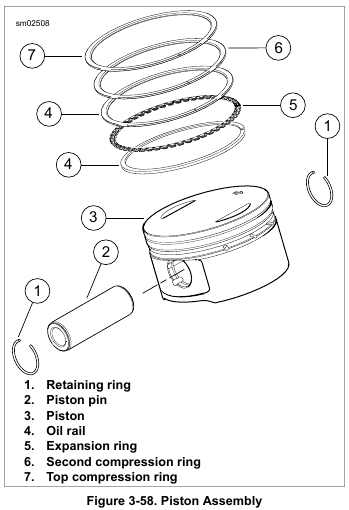
    1. See Figure 3-58. Carefully remove top (7) and second (6) compression rings using the proper PISTON RING EXPANDER (Part No. Snap-on PRS8).

    2. Using your fingers, remove top and bottom oil rails (4) from the third ring groove. Remove the oil rail expansion ring (5).

    3. Discard the piston rings.


  • 2015 Touring – CYLINDER – BORING AND HONING CYLINDER

    1. Bore cylinder with gaskets and torque plates attached.
    Refer to Table 3-36. Bore the cylinder to 0.003 in. (0.08 mm) under the desired finished size.

    An incorrect crosshatch pattern or too fine a hone will result in insufficient oil retention and possible piston seizure and/or high oil consumption. (00538c)

    2. Hone the cylinder to its finished size using a 280 grit rigid hone followed by a 240 grit flexible ball hone. Honing must be done with the torque plates attached. All honing must be done from the bottom (crankcase) end of the cylinder. Work for a 60 degree crosshatch pattern.

    3. Stop frequently to examine the cylinder bore and/or take measurements. Remember, a precise 60 degree crosshatch pattern in the piston travel area is important.

    Failure to remove all abrasive particles may result in premature cylinder, piston and ring wear and engine failure. (00537c)

    4. Thoroughly wash the cylinder bore with liquid dishwashing soap and warm water to remove all abrasive particles and residual grit. Continue cleaning until a clean cloth shows no evidence of dirt or debris.

    5. Hot rinse the cylinder and dry with moisture free compressed air.

    6. Immediately apply a thin film of clean engine oil to a clean white paper towel and thoroughly wipe the inside of the cylinder. This prevents the cylinder bore from rusting.

    NOTE

    After wiping the cylinder with a clean, oiled paper towel, the towel will be dark with contamination. Repeat this process using a new lightly oiled paper towel each time until the towel remains white. The cylinder is now clean.

    7. With the cylinder at room temperature, check the piston clearance in the cylinder in which the piston will run. See 3.24 PISTON, Inspection.


  • 2015 Touring – CYLINDER – DEGLAZING CYLINDER

    NOTE

    Deglazing removes wear patterns, minor scuff marks and scratches without enlarging the bore diameter.

    1. Lightly swab the cylinder bore with a cloth dipped in clean engine oil.

    2. Obtain a 240 grit flexible ball-type deglazing tool with a bristle tip or finishing stone arrangement able to produce a 60 degree crosshatch pattern.

    3. Install the deglazing tool in a slow-speed drill. The speed at which the tool rotates determines the speed at which it must be stroked up and down the bore to produce the desired crosshatch pattern.

    4. Starting at the bottom of the cylinder, move the deglazing tool up and down the entire length of the cylinder bore for 10 to 12 complete strokes.

    5. Stop to examine the cylinder bore and/or take measurements. A precise 60 degree crosshatch pattern in the piston travel area is the most important.

    The angular crosshatch pattern ensures an even flow of oil onto the cylinder walls and promotes longer cylinder, piston and ring life. An incorrect cross hatch pattern will result in insufficient oil retention and possible piston seizure and/or high oil consumption. (00536c)

    Failure to remove all abrasive particles may result in premature cylinder, piston and ring wear and engine failure. (00537c)

    6. Thoroughly wash the cylinder bore with liquid dishwashing soap and hot water to remove all abrasive particles and residual grit. Continue cleaning until a clean cloth shows no evidence of dirt or debris.

    7. Hot rinse the cylinder and dry with moisture free compressed air. Immediately apply a thin film of clean engine oil to a clean white paper towel and thoroughly wipe the inside of the cylinder to prevent the cylinder bore from rusting.

    NOTE

    After wiping the cylinder with a clean, oiled paper towel, the towel will be dark with contamination. Repeat this process using a new lightly oiled paper towel each time until the towel remains white. The cylinder is now clean.

    8. With the cylinder at room temperature, check the piston clearance in the cylinder in which the piston will run. See 3.24 PISTON, Inspection.


  • 2015 Touring – CYLINDER – INSPECTION

    1. Using dye penetrant, inspect the cylinder for cracks. If no cracks are found, thoroughly wash cylinder to remove traces of dye.

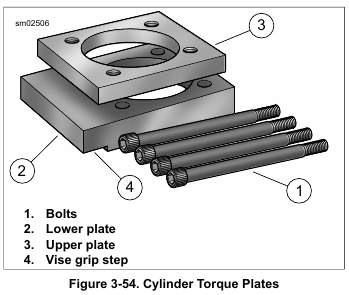
    2. See Figure 3-54. Check the machined surfaces for flatness using a feeler gauge and CYLINDER TORQUE PLATES (Part No. HD-42324-A):
    a. Lay gasket side of the upper torque plate (3) flat against the head gasket surface of the cylinder.
    b. As a preliminary check, see if the plate rocks from side to side. A cylinder on which the plate rocks is immediately suspect.
    c. Insert a feeler gauge between the plate and cylinder at various locations.
    d. The head gasket surface must be flat within 0.006 in. (0.15 mm).
    e. Lay the seal side of the lower torque plate (2) flat against the O-ring seal surface and check flatness using a feeler gauge.
    f. The O-ring seal surface must be flat within 0.004 in. (0.102 mm).
    g. Replace the cylinder (and piston) if either surface exceeds specification.

    NOTE

    Failure to use cylinder torque plates can produce measurements that vary by as much as 0.001 in. (0.025 mm). This may result in the use of parts that are unsuitable for service.

    3. Install CYLINDER TORQUE PLATES (Part No. HD-42324-A) :
    a. Remove O-ring seal from cylinder sleeve, if installed.
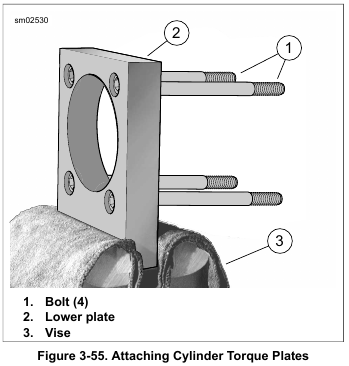
    b. See Figure 3-55. Clamp the stepped side of the lower plate in a vise with soft jaws.
    c. Lightly oil threads and shoulders of four bolts (1) with clean engine oil and slide through holes of lower plate (2).
    d. Slide cylinder onto bolts with the indent in the cooling fins facing upward.
    e. Place a used head gasket on cylinder and install upper plate with blind holes aligned with dowel pins in cylinder. Secure with bolts (1).
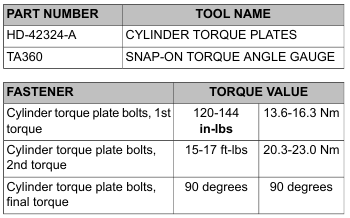
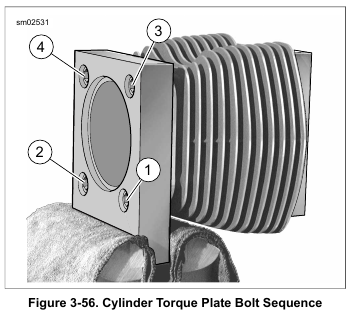
    f. See Figure 3-56. Tighten the bolts to 120-144 in-lbs (13.6-16.3 Nm) in the sequence shown.
    g. Following the same sequence, tighten each bolt to 15-17 ft-lbs (20.3-23.0 Nm).
    h. Final-tighten each bolt an additional 90 degrees (90 degrees) in the same sequence.

    NOTE

    For best results use SNAP-ON TORQUE ANGLE GAUGE (Part No. TA360). If the tool is not available, mark a straight line on each bolt head continuing the line onto the lower plate.

    NOTE

    Maximum cylinder wear occurs at the top of top ring travel. Minimum wear occurs below ring travel. Always take measurements in both areas.

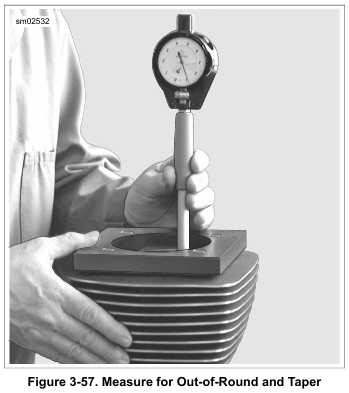
    4. See Figure 3-57. Using an inside micrometer or dial bore gauge, check cylinder bore for out-of round and taper:
    a. At the top of the piston ring travel zone, measure the cylinder diameter at two locations; parallel and perpendicular to the crankshaft. Record the readings.
    b. Repeat the two measurements at the center of the piston ring travel zone and again at the bottom of the bore at a point below the piston ring travel zone.
    c. See 3.3 SERVICE WEAR LIMITS. If the out-of-round or taper measurements are not within specification, the cylinder must be rebored and/or honed to accept the next standard oversize piston. See 3.23 CYLINDER, Boring and Honing Cylinder.
    d. If cylinders are not scuffed or scored and are not worn beyond the service limits, see 3.23 CYLINDER, Deglazing Cylinder.