Author: Sam

  • 2015 Touring – CAM COMPARTMENT AND COMPONENTS – CAM NEEDLE BEARINGS

    Removal

    1. Obtain the CAMSHAFT NEEDLE BEARING REMOVER/INSTALLER (Part No. HD-42325-A).

    2. See Figure 3-99. Remove four thumb screws (1) from threaded holes in support plate (2), if installed.

    3. Sparingly apply clean engine oil (9) to threads of collet (3) to prolong service life and verify smooth operation.

    4. Slide collet through support plate so that threaded end exits stamped side of plate.

    5. Aligning two large holes in support plate with needle bearing bores, hang right side of plate on ring dowel in crankcase flange.

    6. Install thumb screws to secure support plate to crankcase.

    7. Center expandable end of collet in bearing bore and slide bearing (7) and flat washer (5) on threaded end. Start hex nut (8) on threaded end.

    8. Push expandable end of collet through bearing bore into flywheel compartment. Feel for inside edge of needle bearing using end of collet and then back off slightly.

    9. Holding collet to prevent lateral movement, finger tighten hex nut until bearing contacts support plate.

    10. See Figure 3-103. Hold flat on collet to prevent rotation and expand collet by turning hex at end of shaft clockwise. Expandable end of collet makes contact with needle bearing ID.

    11. See Figure 3-98. Turn hex nut clockwise until bearing is free. If necessary, hold flat on collet to prevent rotation.

    12. Remove four thumb screws and pull support plate from crankcase.

    13. Holding flat on collet, turn hex at end of shaft counterclockwise to close collet. Remove and discard needle bearing.

    14. Repeat procedure to remove second needle bearing.

    Installation

    1. Obtain the CAMSHAFT NEEDLE BEARING REMOVER/INSTALLER (Part No. HD-42325-A).

    NOTE

    To avoid engine damage, install needle bearings to the correct depth.

    2. See Figure 3-101. Using a dial caliper, measure thickness of support plate.

    3. Determine the required distance from the top of the support plate to the edge of the installed needle bearing by adding support plate thickness to 3.10 in. (78.7 mm). Record this value.

    NOTE

    For example, if the support plate is 0.50 in. (12.7 mm) thick, then the measurement from the top of the support plate to the edge of the needle bearing should be 3.60 in. (91.4 mm).

    4. See Figure 3-99. Sparingly apply clean engine oil to threads of installer forcing screw (4) to prolong service life and verify smooth operation.

    5. Thread installer forcing screw into stamped side of support plate (2) until threads begin to emerge from opposite side.

    6. Place installer (6) at end of installer forcing screw.

    7. Place new needle bearing on installer with lettered side facing shoulder of installer.

    8. See Figure 3-102. Aligning two large holes in support plate with needle bearing bores, hang right side of plate on ring dowel in crankcase flange.

    9. Install thumb screws to secure support plate to crankcase.

    10. Install first needle bearing as follows:
    a. See Figure 3-103. Turn forcing screw clockwise to press needle bearing into bore.
    b. Back out forcing screw and remove installer. Remove forcing screw from support plate.
    c. See Figure 3-104. Insert dial caliper through forcing screw bore and measure distance from top of support plate to edge of needle bearing.
    d. Repeat steps until bearing is at correct installed depth.
    Temporarily leave tool in this position.

    11. See Figure 3-105. Once the bearing is at correct depth, measure from head (top) of installer forcing screw to support plate. Record this measurement.

    12. Remove forcing screw from support plate and install over second needle bearing bore. Place installer at end of forcing screw. Place new needle bearing on installer with lettered side facing shoulder of installer.

    13. Turn forcing screw until distance from head (top) of forcing screw to support plate equals measurement obtained previously.


  • 2015 Touring – CAM COMPARTMENT AND COMPONENTS – OIL PRESSURE RELIEF VALVE

    Removal

    1. See Figure 3-97. Secure the cam support plate in a vise with soft jaws.

    2. Measurement between piston and bore in cam support plate:
    a. With piston in place, insert straight stiff wire into bore until it bottoms in the piston.
    b. Mark wire at edge of bore in cam support plate.
    c. Remove wire and measure distance from the end to the mark. With piston fully seated in the bore, depth should be approximately 2.25 in (57.15 mm).
    d. If it is less than specified, the piston is not fully seated and a low oil pressure condition will likely be the result.

    3. Use a 1/8 in punch to remove roll pin (1). Discard roll pin.

    4. Remove spring (2) and piston (3) from bypass port.

    Inspection

    NOTE

    A stretched spring or sticking piston can result in high oil pressure.
    1. Inspect spring for stretching, kinks and distortion.

    2. Inspect piston and bore for burrs, scoring or other damage.
    Look for steel particles or aluminum chips. Replace cam support plate and piston if any of these conditions are found.

    3. Measure running clearance of piston in bore. If running clearance exceeds 0.003 in (0.076 mm), install new piston and measure again. Replace cam support plate if running clearance still exceeds specification.

    Installation

    1. Secure the cam support plate in a vise with soft jaws.

    2. See Figure 3-97. Lubricate piston (3) with SCREAMIN’ EAGLE ASSEMBLY LUBE. Slide piston into bypass port of cam support plate with the open side facing outward.

    3. Slide spring (2) into bypass port until seated in piston.

    4. Start new roll pin (1) into hole in cam support plate.
    Compress spring using the blade of a small screwdriver.

    5. Hold spring compressed and tap roll pin into cam support plate until it approaches pin hole on opposite side.

    6. Remove screwdriver to release spring. Verify that spring is straight and square in bore.

    7. Use a 1/8 in punch to install roll pin until flush with casting.


  • 2015 Touring – CAM COMPARTMENT AND COMPONENTS – CAMSHAFTS

    Removal

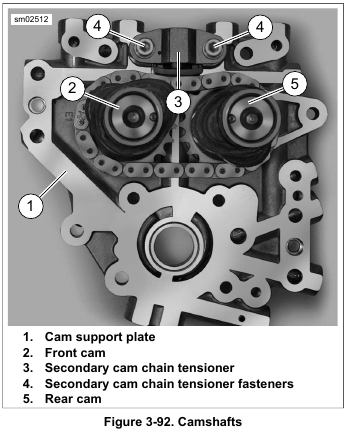
    1. See Figure 3-92. Remove screws (4) and remove secondary cam chain tensioner (3).

    2. Remove retaining ring securing front camshaft. Discard retaining ring.

    3. Remove spacer from front camshaft. Do not mix front and rear camshaft spacers. Front spacer is 0.100 in. (2.54 mm) thick.

    4. Using a colored marker, mark one of the links of the secondary cam chain. Maintaining the original direction of rotation during assembly may prolong service life.

    5. Slide camshafts and secondary cam chain out of cam support plate.

    6. Remove secondary cam chain from cam sprockets.

    Installation

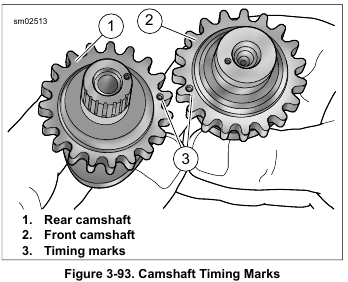
    1. See Figure 3-93. Align timing marks on teeth of secondary cam sprockets.

    NOTE

    Do not mix camshafts during installation. The rear camshaft, identified by the splined shaft, must go into the hole at the rear of the cam support plate.

    2. Place secondary cam chain around sprockets of both front and rear camshafts while keeping timing marks (3) in alignment. To maintain original direction of rotation, verify mark placed on chain link during disassembly is visible during installation.

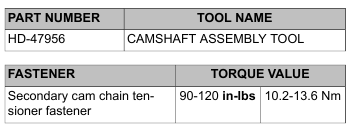
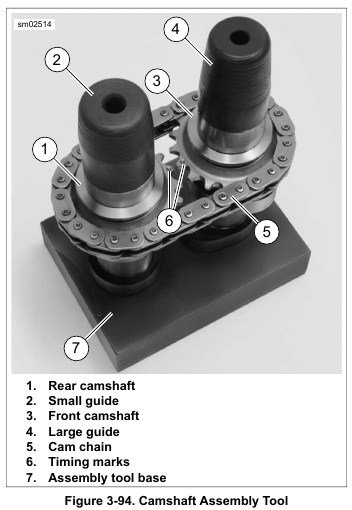
    3. See Figure 3-94. Obtain CAMSHAFT ASSEMBLY TOOL (Part No. HD-47956). Place crankcase side of camshaft/cam chain assembly into assembly tool base (7) while maintaining cam timing mark (6) alignment.

    4. Place small guide (2) on rear camshaft (1). Place large guide (4) on front camshaft (3).

    5. Lubricate support plate camshaft cavities with SCREAMIN’ EAGLE ASSEMBLY LUBE.

    6. Install cam support plate over guides.

    7. Remove guides and base.

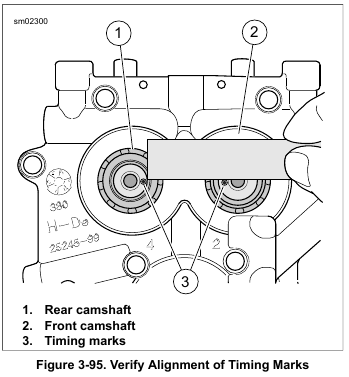
    8. See Figure 3-95. Using a straightedge, verify that the timing marks are in alignment. If they are not, then the camshafts must be removed, realigned and reinstalled.

    9. Install 0.100 in. (2.54 mm) thick front camshaft spacer over end of front camshaft.

    10. With the sharp edge out, install new retaining ring in groove at end of front camshaft.

    11. Inspect primary and secondary cam chain tensioners.
    a. Inspect tensioners for wear. Replace tensioners if damaged or if chain contact portion of shoe material is less than 0.060 in. (1.52 mm) thick.
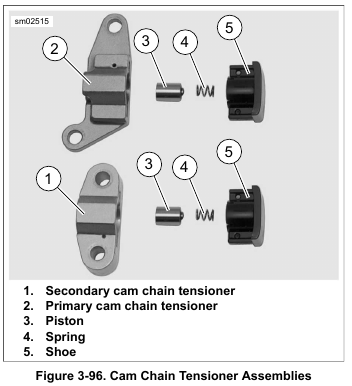
    b. See Figure 3-96. Be sure primary and secondary cam chain tensioners are assembled as shown. If assembled incorrectly, tensioners will not function
    properly.

    12. Install secondary cam chain tensioner and fasteners.
    Tighten to 90-120 in-lbs (10.2-13.6 Nm).


  • 2015 Touring – CAM COMPARTMENT AND COMPONENTS – CAM SUPPORT PLATE CLEANING AND INSPECTION

    Oil Pressure Valve

    Inspect oil pressure valve. See 3.26 CAM COMPARTMENT AND COMPONENTS, Oil Pressure Relief Valve.

    Cam Support Plate

    1. Measure the diameters of the camshaft bores and crank-
    shaft bore. See 3.3 SERVICE WEAR LIMITS, General.

    2. Measure flatness of support plate. See 3.3 SERVICE WEAR LIMITS, General.

    3. Inspect gerotor area for excessive wear or deep grooves.

    4. Verify that all oil holes are clean and open.

    NOTE

    The oiling system is carefully designed for optimum efficiency. All oil holes and passageways are specially sized. Avoid enlarging oil holes during cleaning. Any modification of the oiling system will adversely affect oil pressure or cooling and lubrication efficiency.


  • 2015 Touring – CAM COMPARTMENT AND COMPONENTS – CAM SUPPORT PLATE AND COVER REMOVAL

    Prepare Engine

    NOTE

    The following steps outline removal with the rest of the engine intact. If performing a complete engine overhaul, perform all steps under 3.18 TOP END OVERHAUL: DISASSEMBLY.

    1. Remove breather assembly, rocker arm support plate, pushrods and pushrod covers. Do not remove lifters. See appropriate topics under 3.18 TOP END OVERHAUL: DISASSEMBLY.

    2. See Figure 3-86. Support lifters using SCREAMIN’ EAGLE MAGNETIC LIFTER HOLDERS (Part No. 93979-10).

    NOTE

    Label cam cover screws to aid during assembly.

    3. See Figure 3-85. Remove the socket head screws to release the cam cover. Remove and discard the cam cover gasket.

    Cam Chain and Sprockets Removal

    1. See Figure 3-87. Using a colored marker, mark one of the links (1) of the primary cam chain to identify the visible side. Maintaining the original direction of rotation during assembly may prolong service life.

    NOTE

    Use a piece of wire in retention hole (6) to keep cam chain tensioner components assembled.

    2. Remove primary cam chain tensioner fasteners (4) and primary cam chain tensioner (3).

    NOTE

    Verify side of tool labeled “crank side” faces crankshaft sprocket.

    3. See Figure 3-88. Install CRANKSHAFT/CAMSHAFT SPROCKET LOCKING TOOL (Part No. HD-47941) between cam sprocket (2) and crank sprocket (5).

    Be sure to follow manufacturer’s instructions when using propane torches. Failure to follow manufacturer’s instructions can cause a fire, which could result in death or serious injury. (00465c)

    • Avoid directing heat toward any fuel system component. Extreme heat can cause fuel ignition/explosion resulting in death or serious injury.
    • Avoid directing heat toward any electrical system component.

    NOTES

    • Only use approved methods for removing rear cam bolt.
    Other methods of removal, such as the use of a large breaker bar, may result in damage to chain drive and other components.
    • If necessary, soften threadlocker by using heat from a small propane torch. Apply flame evenly around bolt in a circular motion, but do not allow bolt to turn blue.

    4. Remove the rear cam sprocket bolt and flat washer (1) from the rear cam sprocket (2).

    5. Remove the crank sprocket bolt and flat washer (4) from the crank sprocket (5).

    6. Remove camshaft locking tool.

    7. Use a small pry bar between rear cam sprocket and cam support plate to carefully ease off rear cam sprocket until loose on camshaft.

    8. Use a small pry bar to ease off crank sprocket. Remove both sprockets and primary cam chain.

    Cam Support Plate Removal

    1. See Figure 3-89. Following the sequence shown, remove four socket head screws.

    2. See Figure 3-90. Following the sequence shown, remove six socket head screws to release the cam support plate from the crankcase.

    3. See Figure 3-91. Use a small pry bar between the cam support plate and crankcase flange in areas near the ring dowels (2, 3). Work cam support plate and camshafts from end of crankshaft.


  • 2015 Touring – TOP END OVERHAUL: ASSEMBLY – TWIN-COOLED ENGINE

    Install upper coolant lines. See C.5 COOLING SYSTEM REPAIR. Fill and bleed cooling system. See 1.8 COOLANT.


  • 2015 Touring – TOP END OVERHAUL: ASSEMBLY – BREATHER AND ROCKER COVER

    NOTE

    For breather assembly service procedures, see 3.19 BREATHER ASSEMBLY.

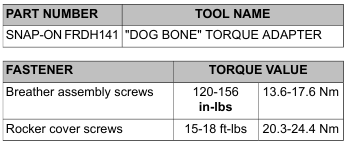
    1. To secure breather assembly, tighten two screws to 120-156 in-lbs (13.6-17.6 Nm).

    NOTE

    If the engine is in the chassis, final tighten the three rocker cover bolts on the left side of the rear cylinder using a 3/8 in. drive torque wrench with a 7/16 in. flank drive “DOG BONE” TORQUE ADAPTER (Part No. Snap-on FRDH141). Failure to properly use this combination will over-tighten the bolts causing distortion of the rocker cover.

    2. Apply a drop of LOCTITE 243 MEDIUM STRENGTH THREADLOCKER AND SEALANT (blue) to threads of rocker cover screws.

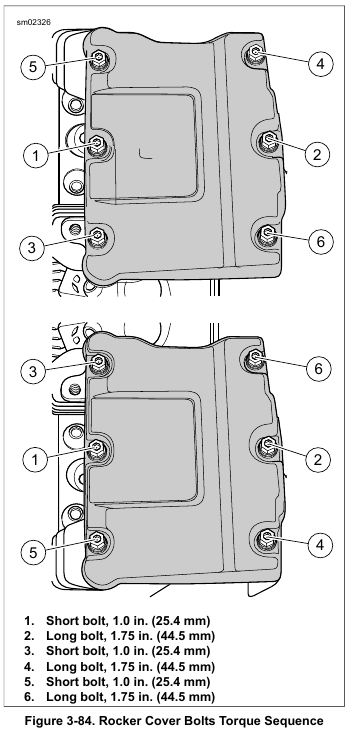
    3. See Figure 3-84. Install rocker cover and a new rocker cover gasket. Tighten screws following the sequence shown to 15-18 ft-lbs (20.3-24.4 Nm).

    4. Complete motorcycle assembly.
    a. If engine was left in the chassis for service, see 3.15 ASSEMBLING MOTORCYCLE AFTER SERVICE.
    b. If engine was removed for service, see 3.17 INSTALLING ENGINE IN CHASSIS.


  • 2015 Touring – TOP END OVERHAUL: ASSEMBLY – ROCKER ARM SUPPORT PLATE

    NOTE

    Installing the rocker arms and rotating the crankshaft with the valve train loaded can result in bent pushrods, damaged bushings or a warped support plate.

    1. Rotate the crankshaft to position both lifters of the cylinder being serviced on the base circle (or lowest position) of the cam lobe.

    2. See Figure 3-82. Place the rocker arm support plate assembly into the rocker housing and loosely install four rocker arm support plate bolts with flat washers.

    NOTE

    Engine in chassis: Final tighten rocker arm support plate bolt on rear left side of rear cylinder using 3/8 in. drive torque wrench with 1/2 in. flank drive SNAP-ON “DOG BONE” TORQUE ADAPTER (Part No. FRDH161) or equivalent.

    3. Tighten rocker arm support plate bolts.
    a. Following the sequence shown, alternately tighten each of the four rocker arm support plate bolts 1/4 turn at a time until snug.
    b. Following the same sequence, tighten the bolts to 18-22 ft-lbs (24.4-29.8 Nm).

    4. Verify that both pushrods spin freely.

    NOTE

    Always service each cylinder separately. After the first cylinder is serviced rotate the crankshaft to find the base circle on the second cam.

    5. Repeat steps on remaining cylinder.

    6. Complete installation of the pushrod covers.
    a. Verify that the O-ring ends of the upper and lower pushrod covers fit snugly into the cylinder head and lifter cover bores.
    b. Insert the upper edge of spring cap retainer into the cylinder head bore leaving the bottom edge free.
    c. Insert blade of small screwdriver between bottom edge of spring cap retainer and top of spring cap.

    NOTE

    For best results, verify that screwdriver, spring cap and spring cap retainer are free of grease and oil.
    d. See Figure 3-83. Press spring cap down with tip of screwdriver and slide bottom edge of retainer towards tip of screwdriver.
    e. Verify that spring cap retainer seats tightly against upper pushrod cover.


  • 2015 Touring – TOP END OVERHAUL: ASSEMBLY – PUSHRODS, LIFTERS AND COVERS

    1. Remove any labels used on the hydraulic lifters. Apply a thin film of SCREAMIN’ EAGLE ASSEMBLY LUBE to outer surface of each lifter. Pour a small amount onto each cam lobe.

    2. Install lifters in the crankcase bores with the oil hole on the inboard side and the flats on the lifters facing forward and rearward. To avoid damage, do not drop lifters onto cam lobes.

    3. See Figure 3-80. Place the anti-rotation pin (4) on the machined flat between the blocks cast into the crankcase.

    4. Install new O-rings in the lifter cover bores and the cylinder head pushrod cover bores.

    NOTE

    During cover installation, verify that the anti-rotation pin (4) is held in place by the ribs (3) cast into the inboard side of the lifter cover. Movement or loss of the pin can result in lifter rotation causing engine damage.

    5. Install the lifter cover (1) and new gasket (2). Install four socket head screws. Tighten the lifter cover screws to 100-120 in-lbs (11.3-13.6 Nm) in a crosswise pattern.

    6. Install pushrod covers.
    a. Assemble pushrod covers with new O-rings.
    b. Hand compress the pushrod cover assembly and fit the pushrod cover into the lifter cover bore.
    c. Extending the assembly, fit the pushrod cover into the cylinder head bore.
    d. Do not install the spring cap retainers at this time.

    NOTE

    To install spring cap retainers, see 3.25 TOP END OVERHAUL: ASSEMBLY, Rocker Arm Support Plate.

    7. Apply a small amount of SCREAMIN’ EAGLE ASSEMBLY LUBE to the ends of each pushrod.

    8. See Figure 3-81. Install the pushrods. If installing original parts, install them in their original locations and orientation. Always remove any tags that may have been used for identification.


  • 2015 Touring – TOP END OVERHAUL: ASSEMBLY – CYLINDER HEAD

    NOTES

    • “Front” or “Rear” is cast into the top of the cylinder head to verify proper installation. The indent in the cooling fins always faces the right side of the engine.
    • Lower the cylinder head at an angle that closely approximates the angle of the crankcase to avoid damage to machined surfaces or the dowel pins.
    • Thoroughly clean and lubricate the threads of the cylinder headbolts before installation. Friction caused by dirt and grime results in a false torque indication.

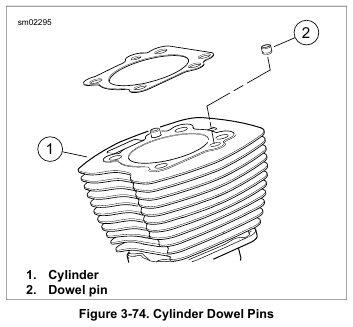
    1. See Figure 3-74. With the part number facing up, place the head gasket over the two dowel pins in the upper flange of the cylinder.

    2. Slide cylinder head squarely over the two cylinder flange dowel pins.

    3. Lightly coat the threads and bottom face of the cylinder headbolts in clean engine oil. Wipe off any excess oil.

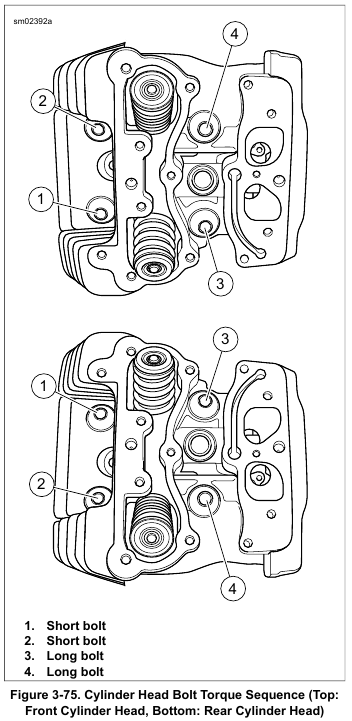
    4. See Figure 3-75. Loosely install the cylinder headbolts.
    Place two short bolts on the left side of the engine and two long bolts on the right.

    NOTE

    Improperly tightened cylinder headbolts may result in gasket leaks, stud failure or distortion of the cylinder and/or cylinder head.

    5. Tighten the cylinder headbolts:
    a. See Figure 3-75. Following sequence shown, turn each cylinder headbolt until finger-tight.
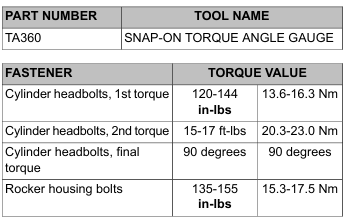
    b. Following the same sequence, tighten the cylinder headbolts to 120-144 in-lbs (13.6-16.3 Nm).
    c. Continuing the same sequence, tighten each bolt to 15-17 ft-lbs (20.3-23.0 Nm).

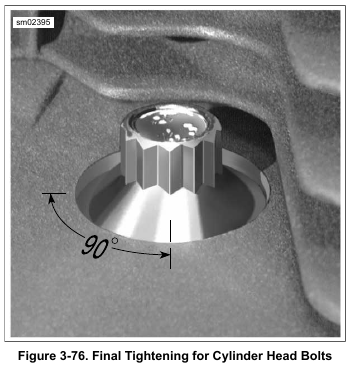
    6. See Figure 3-76. Final-tighten each bolt an additional 90 degrees (90 degrees) in the same sequence. For best results, use SNAP-ON TORQUE ANGLE GAUGE (Part No. TA360).
    a. If using a grease pencil, mark a straight line on the cylinder headbolt continuing the line over onto the cylinder head.
    b. Use the marks as a guide to achieve the 90 degrees.

    NOTE

    The tips of ACR solenoids for Twin-Cooled engines are approximately 0.500 in (13 mm) longer than those for air-cooled engines. Twin-Cooled ACR’s will contact the pistons of an air cooled engine.

    7. 103 and larger engines: Install the ACR. See 7.19 AUTOMATIC COMPRESSION RELEASE (ACR).

    NOTES

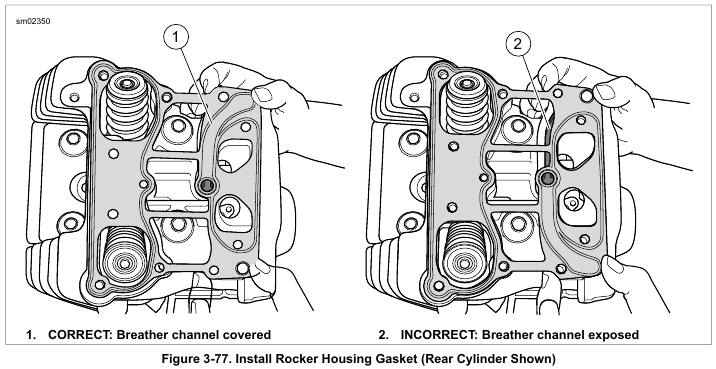
    • The rocker housing gasket can be installed upside down resulting in an open breather channel. This causes a major oil leak when the vehicle is started, possibly resulting in engine and/or property damage.

    • On front cylinder head, install side of gasket marked “front” facing up. On rear cylinder head, install side of gasket marked “rear” facing up.

    8. See Figure 3-77. Install a new rocker housing gasket on the cylinder head. Verify that the rocker housing gasket covers the breather channel.

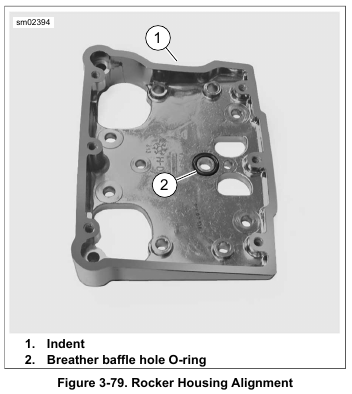
    9. See Figure 3-79. Install rocker housing.
    a. With the indent (1) facing forward, place the rocker housing into position aligning the holes in the housing with those in the gasket.
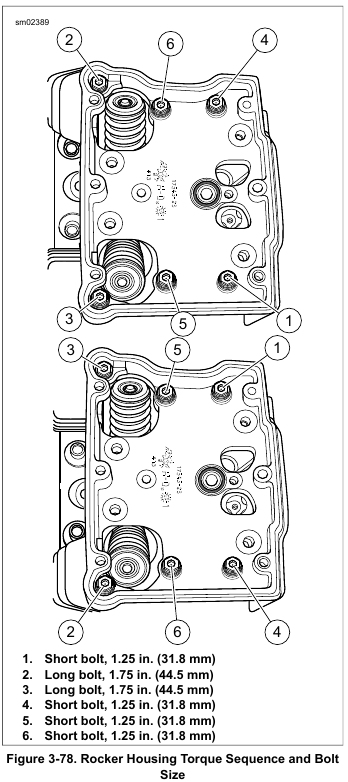
    b. See Figure 3-78. Apply a drop of LOCTITE 243 MEDIUM STRENGTH THREADLOCKER AND SEALANT (blue) to threads of six rocker housing bolts.
    c. Loosely install the rocker housing bolts.
    d. Place two long bolts on the left side of the engine and four intermediate bolts in the interior.
    e. Tighten the bolts in the sequence shown to 135-155 in-lbs (15.3-17.5 Nm).

    NOTES

    • If the engine was left in the chassis for service, final tighten the rear left rocker housing bolt (rear cylinder) using a torque wrench with a 1/4 in. drive.
    • Since many O-rings are similar in size and appearance, always use new O-rings, keeping them packaged until use to avoid confusion. Use of the wrong O-ring will result in either oil leakage or low oil pressure. Keep them packaged until use to avoid confusion.

    10. See Figure 3-79. Apply a very thin film of clean engine oil to new baffle hole O-ring (2). Install new O-ring in groove around breather baffle hole in rocker housing.

    NOTE

    Do not confuse breather baffle hole O-ring (Part No. 11270, large inner diameter) with the top pushrod O-ring (Part No. 11293, small inner diameter).