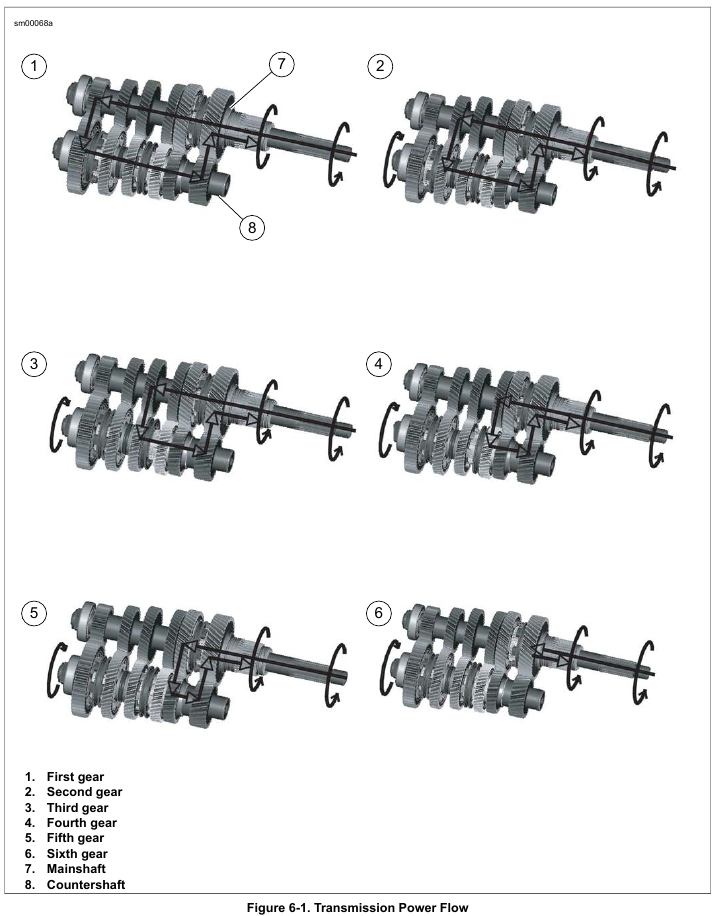
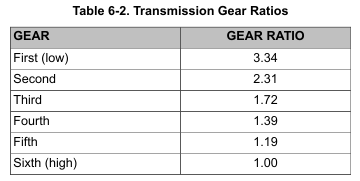
See Figure 6-1. The 6-speed transmission consists of two parallel shafts supporting six gears each. The longer, or mainshaft (7), also supports the clutch and serves as the input shaft. The shorter shaft is called the countershaft (8).
Each gear on the mainshaft is in constant mesh with a corresponding gear on the countershaft. Each of these six pairs of gears makes up a different speed in the transmission.
The transmission gears are divided into two types, gears that rotate with the shaft, and gears that spin freely on the shaft. A gear that rotates with the shaft always meshes with a freewheeling gear. Also, three dog rings are able to slide sideways on the shaft. These dog rings are used to change transmission speeds. The dogs on the sides of dog rings engage dogs on adjacent freewheeling gears, transmitting power through the transmission.
Gear shifting is accomplished by three forks which fit into grooves machined into the dog rings that slide on the guide hubs. The position of the shifter forks is controlled by a drumshaped shifter cam located in the transmission bearing housing.
Neutral
Power is introduced to the transmission through the clutch. In neutral, with the clutch engaged, the mainshaft 1st, 2nd, 3rd and 4th gears are rotating. No power is transferred to the countershaft since countershaft 1st, 2nd, 3rd and 4th gears are freewheeling gears.
First Gear
When the transmission is shifted into first gear, the dog ring between countershaft 1st and 2nd, which rotates with the countershaft, engages countershaft 1st, which has been spinning freely on the countershaft driven by mainshaft 1st.
Now countershaft 1st is no longer freewheeling, but locked to the countershaft causing the countershaft and countershaft 6th to turn. Countershaft 6th transmits the power to the main drive gear and the sprocket as shown (1).
Second Gear
Second gear is engaged when the dog ring between countershaft 1st and 2nd is shifted out of countershaft 1st and engages countershaft 2nd. This locks countershaft 2nd to the countershaft to complete the power flow as shown (2).
Third Gear
Two shifter forks are used to make the shift from second to third. One fork moves the dog ring between countershaft 1st and 2nd to its neutral position. At the same time another fork engages the dog ring between countershaft 3rd and 4th with countershaft 3rd. This locks countershaft 3rd to the countershaft to complete the power flow as shown (3).
Fourth Gear
Fourth gear is engaged when the dog ring between countershaft 3rd and 4th is shifted out of countershaft 3rd and engages countershaft 4th. This locks countershaft 4th to the countershaft to complete the power flow as shown (4).
Fifth Gear
Two shifter forks are used to make the shift from fourth to fifth. One fork moves the dog ring between countershaft 3rd and 4th to its neutral position. At the same time another fork engages the dog ring between mainshaft 5th and 6th with mainshaft 5th. This locks mainshaft 5th to the mainshaft to complete the power flow as shown (5).
Sixth Gear
The shift from fifth to sixth gear occurs when the dog ring between mainshaft 5th and 6th is shifted out of mainshaft 5th. It is shifted directly into the main drive gear (6th gear). The main drive gear is locked to the mainshaft. this results in a direct one-to-one drive ratio from the clutch to the sprocket as shown (6).