Disconnect negative (-) battery cable first. If positive (+) cable should contact ground with negative (-) cable connected, the resulting sparks can cause a battery explosion, which could result in death or serious injury. (00049a)
1. Disconnect battery.
2. Drain engine oil. See 1.6 ENGINE OIL AND FILTER.
3. Drain transmission. See 1.11 TRANSMISSION LUBRICANT.
4. Remove starter. See 7.8 STARTER.
5. Remove transmission assembly. See 6.8 TRANSMISSION ASSEMBLY.
6. Remove oil pan. See 3.31 OIL PAN, Removal.
When lifting a motorcycle using a jack, be sure jack contacts both lower frame tubes where down tubes and lower frame tubes converge. Never lift by jacking on crossmembers, oil pan, mounting brackets, components or housings. Failure to comply can cause serious damage resulting in the need to perform major repair work. (00586d)
7. Position jack across lower frame to support rear of motorcycle. Slide wooden blocks beneath the crankcase to support the weight of the engine and transmission assembly.
8. Remove rear fork. See 2.22 REAR FORK.
9. Disconnect vehicle speed sensor (VSS).
See 7.22 VEHICLE SPEED SENSOR (VSS).
10. Disconnect neutral switch. See 7.24 NEUTRAL SWITCH, Removal.
11. Remove battery negative ring terminal from ground post at top of transmission case.
12. Move aside the harness that terminates at the O2 sensor, starter solenoid, neutral switch and VSS.
13. Mark splines on shift arm and shift shaft to help with assembly. Remove shift arm from shift shaft.
14.In a crosswise pattern, remove four fasteners that connect transmission to engine.
NOTE
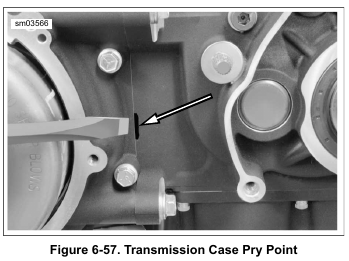
See Figure 6-57. Do not use a hammer to remove transmission. If the transmission sticks or binds on the ring dowels, gently pry away from crankcase using the pry point.
15. Move transmission rearward until two ring dowels in lower flange are free of crankcase. Remove transmission case from left side of the motorcycle.
Leave a Reply